#is-10262#concrete-mix-design#m25-concrete#concrete-technology#is-456#quality-control
M25 Concrete Mix Design (IS 10262:2019) — Worked Example
Step-by-step M25 concrete mix design to IS 10262:2019: target strength, w/c ratio, cement and aggregate quantities per m³, with hand calculation.
Updated 4 Nov 202612 min read
 Try it free: open this worked example in Concrete Mix DesignOpen →
On this page
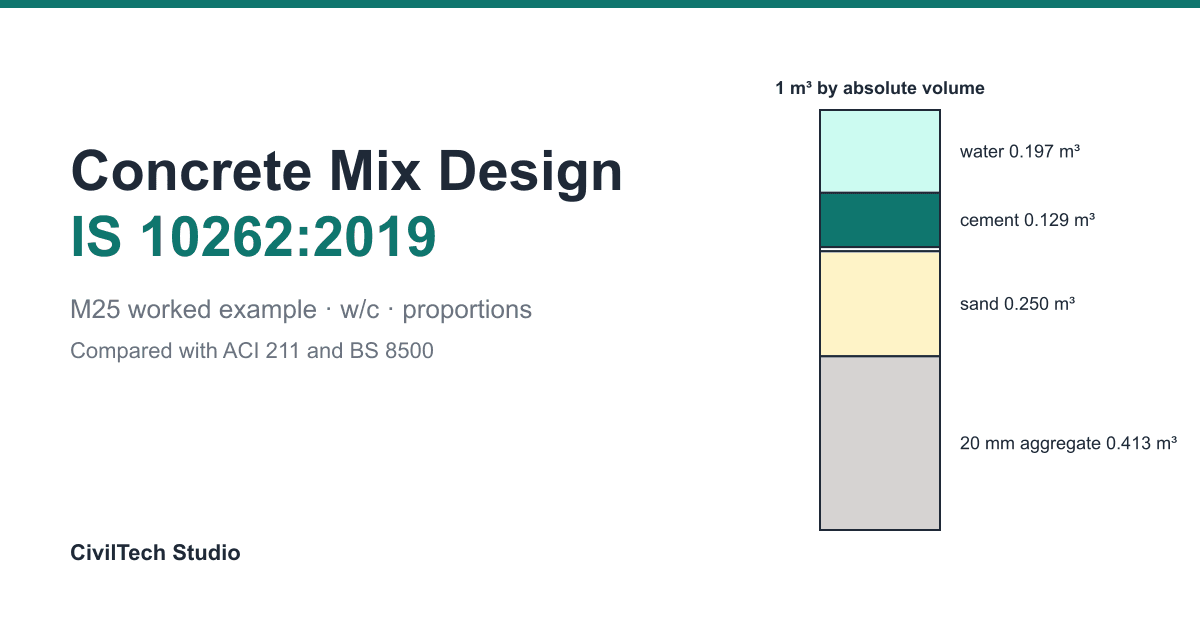
An M25 concrete mix designed to IS 10262:2019 starts from a target mean strength of 31.6 MPa (25 + 1.65 × 4.0), picks a water–cement ratio that meets both that strength and the IS 456 exposure limit, and then shares out the rest of the cubic metre between sand and coarse aggregate by absolute volume. For OPC 53 cement, 20 mm crushed coarse aggregate, Zone II sand, 100 mm slump and moderate exposure, the result is roughly 197 kg water, 407 kg cement, 663 kg sand and 1,116 kg coarse aggregate per m³. That is a w/c of 0.484, a mass ratio of 1 : 1.63 : 2.74, and 8.15 bags of cement per m³. The rest of this article explains each step and checks every number by hand.
You can run your own mix with the free IS 10262 concrete mix design calculator.
What governs concrete mix design in India
- IS 10262:2019 is the mix proportioning method: target strength, w/c, water content, aggregate proportions and trial mixes.
- IS 456:2000 Table 5 sets the durability limits for each exposure class: maximum w/c, minimum cement content and minimum grade. These often govern ahead of strength.
- IS 383 covers aggregates and the fine-aggregate grading zones (I to IV).
- IS 456 Table 9 lists nominal mixes. IS 456 permits nominal mixes only up to M20, so M25 and above should be design mixes.
The exposure limits the module applies (IS 456 Table 5, reinforced concrete):
| Exposure | Max free w/c | Min cement (kg/m³) | Min grade |
|---|---|---|---|
| Mild | 0.55 | 300 | M20 |
| Moderate | 0.50 | 300 | M25 |
| Severe | 0.45 | 320 | M30 |
| Very severe | 0.45 | 340 | M35 |
| Extreme | 0.40 | 360 | M40 |
| Water-retaining (module option) | 0.45 | 350 | M30 |
IS 10262:2019 mix design procedure, step by step
Step 1: Target mean strength
f'ck = max( fck + 1.65 S , fck + X )
| Grade | Assumed S, MPa (Table 2) | X, MPa (Table 1) |
|---|---|---|
| M10–M15 | 3.5 | 5.0 |
| M20–M25 | 4.0 | 5.5 |
| M30–M60 | 5.0 | 6.5 |
| M65–M80 | 6.0 | 8.0 |
The X rule is new in the 2019 revision. It stops a site with a very low standard deviation from designing with an unrealistically small margin. Once you have 30 or more test results from your own site, use your own S.
Step 2: Water–cement ratio
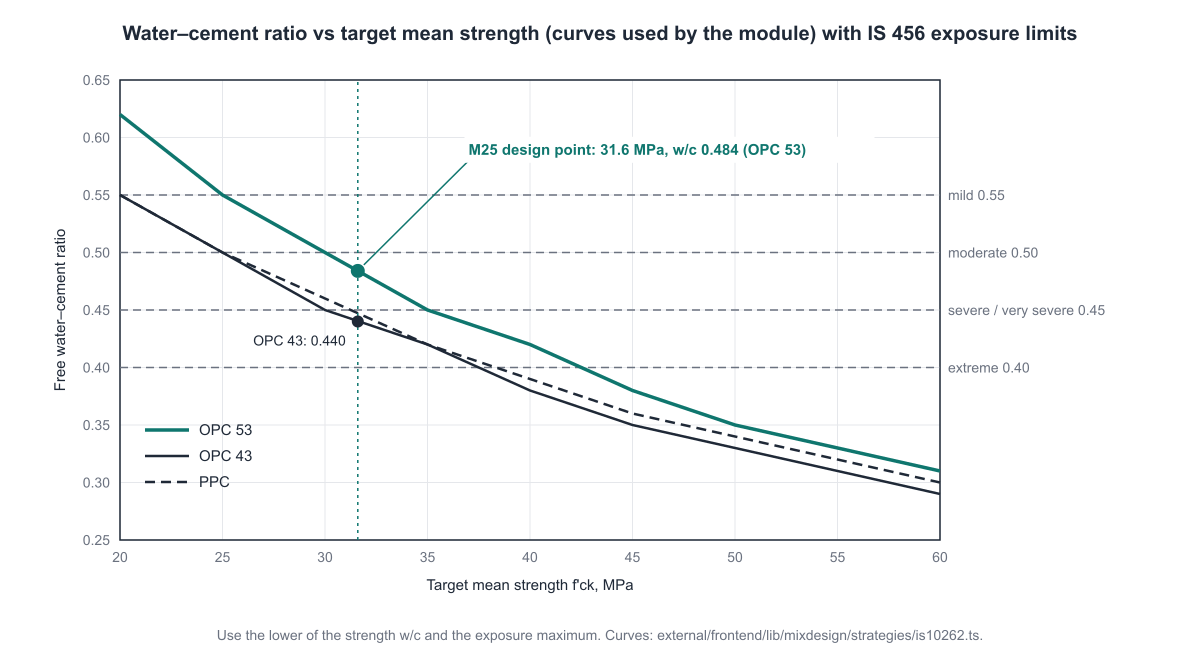
Read the w/c for the target strength off the strength–w/c relationship for your cement, then compare it with the IS 456 Table 5 maximum for the exposure. Use whichever is lower. The module stores a strength–w/c curve for each cement type (OPC 33, 43 and 53, PPC and PSC) and reports which limit governed.
Step 3: Water content
The starting water content for a 50 mm slump depends on the maximum aggregate size: 208 kg/m³ for 10 mm, 186 kg/m³ for 20 mm and 165 kg/m³ for 40 mm (IS 10262 Table 4, angular aggregate). Add 3 % for every 25 mm of slump above 50 mm. Subtract the admixture's water reduction if you use one.
Step 4: Cement content
C = W / (w/c) not less than the IS 456 Table 5 minimum
Step 5: Coarse aggregate proportion
IS 10262 Table 5 gives the coarse aggregate volume as a fraction of the total aggregate volume, at w/c = 0.50, by aggregate size and sand zone. For 20 mm aggregate the values are 0.60, 0.62, 0.64 and 0.66 for Zones I to IV. Add 0.01 for every 0.05 the w/c falls below 0.50, and subtract 0.01 for every 0.05 it rises above. For pumpable concrete the coarse fraction may be cut by up to 10 %.
Step 6: Absolute volume
V_aggregate = 1 − W/1000 − C/(1000·SGc) − air
CA = V_aggregate × p_CA × SG_CA × 1000
FA = V_aggregate × (1 − p_CA) × SG_FA × 1000
The entrapped air allowance is 1.5 % for 10 mm, 1.0 % for 20 mm and 0.8 % for 40 mm aggregate (IS 10262 Table 3).
Step 7: Correct for aggregate moisture
The quantities above assume saturated surface-dry (SSD) aggregates. Wet sand brings extra water into the mix and dry stone soaks some up. Adjust the batch water and aggregate weights accordingly.
Step 8: Trial mixes
Make trial batches, measure slump, density and 7- and 28-day strength, then adjust. The design is a starting point, not a certificate.
Worked example: M25 concrete mix design to IS 10262:2019
Inputs (the module's defaults plus realistic site moisture)
| Parameter | Value |
|---|---|
| Grade | M25, standard deviation not known |
| Exposure | Moderate |
| Cement | OPC 53, specific gravity 3.15 |
| Coarse aggregate | 20 mm crushed (angular), SG 2.70, absorption 0.5 %, moisture 0 % |
| Fine aggregate | Zone II, SG 2.65, absorption 1.0 %, moisture 2.0 % |
| Slump | 100 mm |
| Admixture | None |
Hand calculation
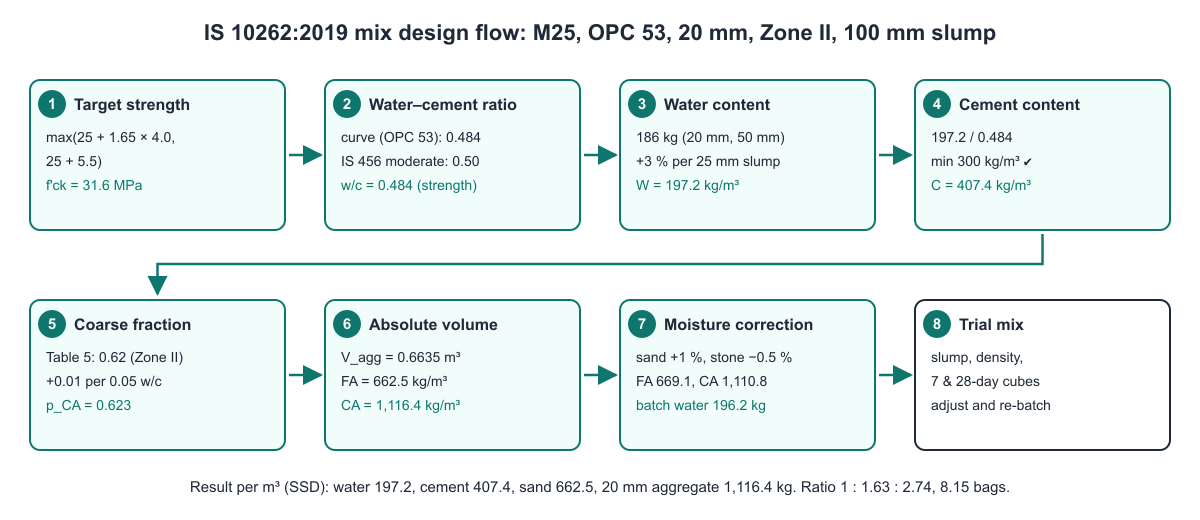
1. Target strength   25 + 1.65 × 4.0 = 31.6 MPa;  25 + 5.5 = 30.5 MPa  →  f'ck = 31.6 MPa

2. w/c               OPC 53 curve: 0.50 at 30 MPa, 0.45 at 35 MPa
                     0.50 − (31.6 − 30)/5 × 0.05 = 0.484
                     IS 456 moderate max 0.50  →  0.484 governs (strength)

3. Water             186 × (1 + (100 − 50)/25 × 0.03) = 186 × 1.06 = 197.2 kg/m³

4. Cement            197.2 / 0.484 = 407.4 kg/m³  (≥ 300 minimum ✔)

5. CA fraction       0.62 + (0.50 − 0.484)/0.05 × 0.01 = 0.6232

6. Volumes           water 0.1972, cement 407.4/3150 = 0.1293, air 0.010 m³
                     V_agg = 1 − 0.1972 − 0.1293 − 0.010 = 0.6635 m³
                     CA = 0.6635 × 0.6232 × 2700 = 1,116.4 kg/m³
                     FA = 0.6635 × 0.3768 × 2650 =   662.5 kg/m³

7. Moisture          sand: +1.0 % surface water = 6.6 kg  → sand 669.1 kg, water −6.6
                     stone: −0.5 % (absorbs)    = 5.6 kg  → stone 1,110.8 kg, water +5.6
                     batch water = 197.2 − 6.6 + 5.6 = 196.2 kg/m³
Engine output
| Item | SSD design (kg/m³) | Batch with site moisture (kg/m³) |
|---|---|---|
| Water | 197.2 | 196.2 |
| Cement (OPC 53) | 407.4 | 407.4 |
| Fine aggregate | 662.5 | 669.1 |
| Coarse aggregate (20 mm) | 1,116.4 | 1,110.8 |
| Target mean strength | 31.6 MPa | |
| w/c | 0.484 (strength governs) | |
| Air | 1.0 % | |
| Mix ratio by mass | 1 : 1.63 : 2.74 | |
| Cement bags (50 kg) per m³ | 8.15 | |
| Absolute volume total | 1.000 m³ | |
| Checks | Min cement ✔, w/c for strength ✔, max w/c ✔, min grade ✔ |
The fresh density works out to 197.2 + 407.4 + 662.5 + 1,116.4 = 2,383.5 kg/m³, which is sensible for normal-weight concrete.
Per bag of cement, for site volume batching: 24.2 kg water, 81.3 kg sand (1.79 cft at 1,600 kg/m³ loose bulk density) and 137.0 kg aggregate (3.23 cft at 1,500 kg/m³). Use bulk densities measured on your own site. The cft figures change a lot with moisture and bulking.
Why 407 kg of cement for M25?
Because there is no admixture at 100 mm slump. The mix needs 197 kg of water for workability, and the w/c locks the cement to that water. The engine's sensitivity runs show the levers:
| Variation (from the worked example) | w/c (governs) | Water | Cement | Mix ratio |
|---|---|---|---|---|
| Worked example (OPC 53, moderate) | 0.484 (strength) | 197.2 | 407.4 | 1 : 1.63 : 2.74 |
| OPC 43 | 0.440 (strength) | 197.2 | 448.2 | 1 : 1.42 : 2.48 |
| PPC | 0.447 (strength) | 197.2 | 441.2 | 1 : 1.45 : 2.52 |
| 8 % water-reducing admixture | 0.484 (strength) | 181.4 | 374.8 | 1 : 1.83 : 3.08 |
| Pumpable (CA −10 %) | 0.484 (strength) | 197.2 | 407.4 | 1 : 1.90 : 2.47 |
| Severe exposure | 0.45 (exposure) | 197.2 | 438.2 | 1 : 1.46 : 2.54, and fails min grade (severe needs M30) |
An 8 % water reducer saves about 33 kg of cement per m³ at the same w/c. In practice that is the cheapest way to bring cement down. Moving M25 into severe exposure is not allowed at all: IS 456 asks for at least M30. You can rerun these cases with your own materials in the M25 mix design calculator.
IS 10262 vs ACI 211.1 vs BS 8500 / EN 206
The module runs all three methods. A like-for-like comparison has to allow for the specimen difference: IS grades are 150 mm cube strengths, while ACI f'c and EN fck are cylinder strengths. M30 (cube) is roughly C25/30, or f'c 25 MPa. With the same aggregates, 100 mm slump and no admixture:
| Method | Grade entered | Margin rule (σ unknown) | Target | w/c | Water | Cement | FA | CA | Air |
|---|---|---|---|---|---|---|---|---|---|
| IS 10262:2019 | M30, moderate, OPC 53 | max(fck + 1.65 × 5.0, fck + 6.5) | 38.25 | 0.431 | 197.2 | 457.5 | 628.4 | 1,108.1 | 1.0 % |
| ACI 211.1 | f'c 25, exposure W1, Type I | f'c + 8.3 (21–35 MPa) | 33.3 | 0.494 | 205.0 | 415.0 | 731.0 | 992.0 | 2.0 % |
| BS 8500 / EN 206 | C25/30, XC3, CEM I | fck + 12 (module margin, fck ≤ 25) | 37.0 | 0.48 | 195.7 | 407.7 | 804.5 | 948.4 | 2.0 % |
All quantities are in kg/m³ and targets in MPa. The methods differ in their margins, their strength–w/c data and how they split fine and coarse aggregate. ACI 211.1 reads its coarse aggregate figure (b/b0 = 0.62 here) as the dry-rodded volume of coarse aggregate per m³ of concrete, so CA = 0.62 × 1,600 kg/m³ = 992 kg, and the sand fills the rest of the absolute volume. The BS method puts noticeably more sand in the mix. None of these is "the right answer"; each is a starting point for a trial mix under the code your project specifies.
IS clause reference for mix design
| Topic | Reference | What it gives |
|---|---|---|
| Target mean strength | IS 10262:2019 Cl 4.2, Tables 1 & 2 | f'ck, X and assumed S |
| Water content | IS 10262:2019 Table 4 | Water by aggregate size, slump correction |
| Entrapped air | IS 10262:2019 Table 3 | 1.5 / 1.0 / 0.8 % |
| Coarse aggregate volume | IS 10262:2019 Table 5 | CA fraction by size and zone |
| Durability limits | IS 456:2000 Table 5 | Max w/c, min cement, min grade |
| Nominal mixes | IS 456:2000 Table 9 | Up to M20 only |
| Aggregate grading | IS 383 | Zones I–IV, coarse aggregate grading |
| Acceptance of concrete | IS 456:2000 Cl 16 | Compliance criteria for cube results |
Common mistakes in concrete mix design
- Forgetting the exposure check. Strength alone may give a w/c of 0.55 where IS 456 caps it at 0.45.
- Using the old 2009 target formula (fck + 1.65 S only) instead of the 2019 rule that takes the higher of that and fck + X.
- Mixing up cube and cylinder strength when comparing IS with ACI or EN designs.
- Batching SSD quantities directly. Wet sand can add 10 to 20 kg of water per m³ and quietly lower the strength.
- Converting to cft with particle density (about 2,650 kg/m³) instead of loose bulk density. This understates site volumes by roughly 40 %.
- Skipping the trial mix. Cement strength, aggregate shape and admixture compatibility vary from site to site.
- Piling on cement to "be safe". It raises heat and shrinkage cracking. The module warns above 450 kg/m³ and caps cement at 600 kg/m³.
How CivilTech Studio does this
The concrete mix design calculator runs in the browser:
- Three methods: IS 10262:2019, ACI 211.1 and BS 8500 / EN 206, with each code's exposure classes and cement types, and a side-by-side comparison panel.
- Full IS 10262 steps: target strength (Tables 1 and 2), w/c from strength and exposure, slump correction, coarse fraction correction, absolute volume, a volume check, moisture correction and compliance checks.
- Options: chemical admixture with water reduction, fly ash and GGBS replacement with effective water–binder ratio, self-compacting concrete mode, pumpable concrete, and a manual w/c override.
- Optimiser: sweeps grade and cement type and ranks mixes by material cost.
- Aggregate grading: sieve analysis with a grading curve and a check against the code envelopes.
- Trial mixes and QC: enter measured slump, density and 7- and 28-day strengths to get adjustment advice and adjusted proportions; log cube results to get mean, standard deviation and a control chart.
- Outputs: a nominal-mix conversion (bags and cft per bag using loose bulk density), plus PDF, Excel and a step-by-step calculation report.
Log your site cube results in the cube test register. The module's water-retaining exposure class feeds directly into water tank design. To price the cement and aggregate, use the RC estimator.
FAQ
What is the mix ratio of M25 concrete?
IS 456 gives nominal mixes only up to M20, so M25 should be a design mix. For the materials in this example, the design mix is 1 : 1.63 : 2.74 by mass with a w/c of 0.484. The traditional "1:1:2" is a rule of thumb, not an IS 456 nominal mix.
What is the target mean strength for M25 as per IS 10262:2019?
31.6 MPa: the higher of 25 + 1.65 × 4.0 = 31.6 and 25 + 5.5 = 30.5.
What is the water–cement ratio for M25 concrete?
The maximum is 0.50 for moderate exposure (IS 456 Table 5). The design value comes from the strength curve for your cement. It is 0.484 for OPC 53 in this example and about 0.44 for OPC 43.
How many bags of cement are needed for 1 m³ of M25 concrete?
It depends on the design. This example uses 407.4 kg, or 8.15 bags of 50 kg, without admixture. With an 8 % water-reducing admixture it drops to 374.8 kg, or 7.5 bags.
What changed in IS 10262:2019 compared with 2009?
The target strength is now the higher of fck + 1.65 S and fck + X (Table 1), and the assumed standard deviations were revised (Table 2). The code also covers higher grades; this module offers grades up to M100.
Why is my mix design cement content above 400 kg/m³?
Usually because of high slump without an admixture, a lower-grade cement (OPC 43 needs a lower w/c than OPC 53 for the same strength), or strict exposure limits. A water-reducing admixture is the usual fix.
Does the calculator correct for moisture in sand?
Yes. Enter moisture content and absorption for both aggregates. The batch quantities then show the corrected water and the wet aggregate weights.
Educational reference. Always verify against the governing code and your project specification.