#is-456#reinforcement#detailing#rcc#lap-length
Development & Lap Length (IS 456) — Formula & Example
How to calculate development length (Ld) and lap length to IS 456:2000 Cl 26.2, with a ready Ld/φ table for Fe 415, Fe 500 and Fe 550 and a worked example for a 16 mm bar.
Updated 4 Nov 20264 min read
On this page
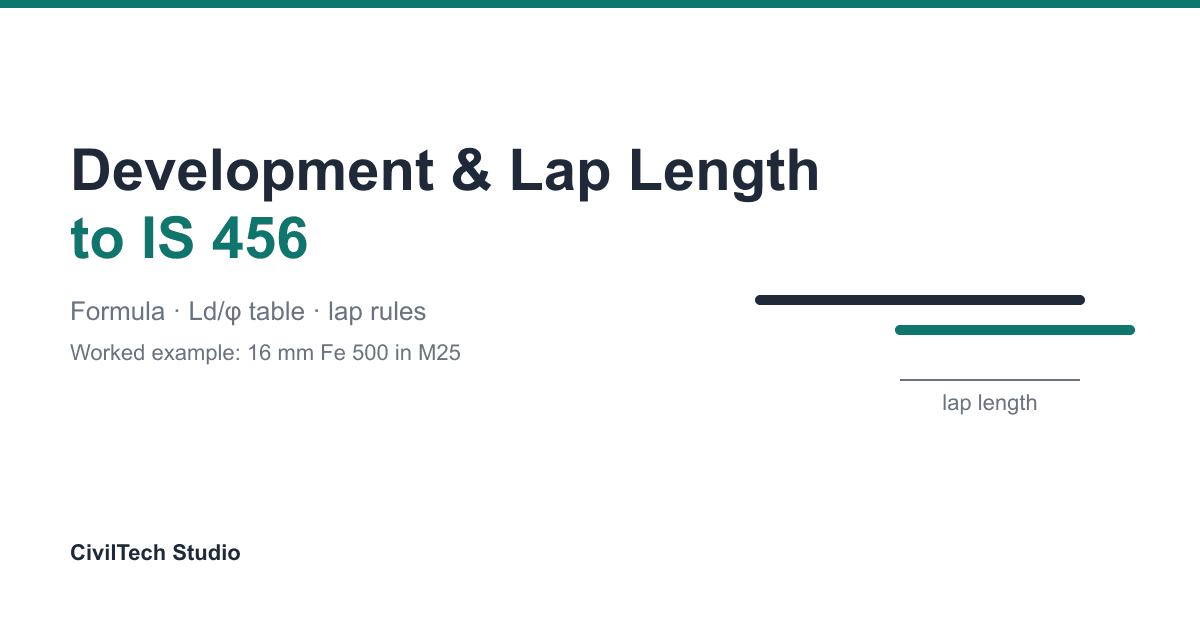
Every bar in a reinforced concrete member has to be anchored far enough into the concrete that it yields before it pulls out. That anchorage distance is the development length, Ld. When a bar is too short and has to be joined to another, the overlap is the lap length. Both come from IS 456:2000 Clause 26.2, and both are among the most-checked numbers on any site.
This post gives the formula, a ready table you can use without a calculator, and a worked example. To try your own bar size and grade, use the free development and lap length calculator.
The formula (IS 456 Cl 26.2.1)
Ld = φ × σs / (4 × τbd)
- φ: bar diameter (mm)
- σs: stress in the bar at the design load. For limit state design, take σs = 0.87 fy.
- τbd: design bond stress (MPa) from Cl 26.2.1.1
Design bond stress, τbd
For plain bars in tension, IS 456 gives:
| Concrete | M20 | M25 | M30 | M35 | M40 and above |
|---|---|---|---|---|---|
| τbd (MPa) | 1.2 | 1.4 | 1.5 | 1.7 | 1.9 |
Then adjust it:
- Deformed bars (HYSD, Fe 415 and above): increase by 60% (×1.6).
- Bars in compression: increase by a further 25% (×1.25).
Fe 250 mild steel is a plain bar. Fe 415, Fe 500 and Fe 550 are deformed HYSD bars (IS 1786), so the ×1.6 always applies to them.
Ready table: Ld as a multiple of bar diameter
Multiply the value by your bar diameter to get Ld in mm.
| Steel | M20 | M25 | M30 | M35 | M40 |
|---|---|---|---|---|---|
| Fe 415, tension | 47.0φ | 40.3φ | 37.6φ | 33.2φ | 29.7φ |
| Fe 415, compression | 37.6φ | 32.2φ | 30.1φ | 26.5φ | 23.8φ |
| Fe 500, tension | 56.6φ | 48.5φ | 45.3φ | 40.0φ | 35.8φ |
| Fe 500, compression | 45.3φ | 38.8φ | 36.2φ | 32.0φ | 28.6φ |
| Fe 550, tension | 62.3φ | 53.4φ | 49.8φ | 44.0φ | 39.4φ |
| Fe 550, compression | 49.8φ | 42.7φ | 39.9φ | 35.2φ | 31.5φ |
The common site rule of "50d" is close to Fe 500 in M25 (48.5φ), but it is unsafe for Fe 500 in M20 (56.6φ) and for Fe 550.
Worked example: 16 mm Fe 500 bar in M25
- τbd for M25 = 1.4 MPa. The bar is deformed, so τbd = 1.4 × 1.6 = 2.24 MPa.
- σs = 0.87 × 500 = 435 MPa.
- Ld = 16 × 435 / (4 × 2.24) = 6960 / 8.96 = 776.8 mm, say 780 mm (48.5φ).
The same bar in compression: τbd = 2.24 × 1.25 = 2.80 MPa, so Ld = 6960 / 11.2 = 621.4 mm.
Lap length (IS 456 Cl 26.2.5.1)
| Situation | Lap length |
|---|---|
| Flexural tension (beams, slabs) | the larger of Ld and 30φ |
| Direct tension (ties, tension members) | the larger of 2Ld and 30φ |
| Compression (columns) | the larger of Ld (compression) and 24φ |
For the 16 mm Fe 500 bar in M25:
- In a beam (flexural tension): max(776.8, 480) = 776.8 mm
- In a tie (direct tension): max(1553.6, 480) = 1553.6 mm
- In a column (compression): max(621.4, 384) = 621.4 mm
In practice the 30φ minimum only governs at the low end. For example, Fe 415 in M40 has Ld = 29.7φ, so its tension lap becomes 30φ.
Rules people forget
- No lap splices for bars larger than 36 mm (Cl 26.2.5.1a). Weld them or use mechanical couplers.
- Stagger the laps. Where possible, don't lap more than half the bars at one section, and keep laps away from points of maximum moment.
- Ld is measured from the critical section, the point where the bar needs its full design stress, not from the face of the support.
Frequently asked questions
What is the formula for development length in IS 456?
Ld = φ × σs / (4 × τbd) (Cl 26.2.1), where φ is the bar diameter, σs = 0.87 fy at the design load, and τbd is the design bond stress. For deformed bars (Fe 415, Fe 500, Fe 550) τbd is increased by 60%, and by a further 25% for bars in compression.
Is 50d enough for development length?
Only in some cases. 50d is close to Fe 500 in M25 (48.5φ in tension), but it is too short for Fe 500 in M20 (56.6φ) and for Fe 550 in M20 and M25 (62.3φ and 53.4φ). Check the table above for your grade of steel and concrete.
What is the lap length for a column?
For bars in compression, the lap length is the larger of the compression development length and 24φ (Cl 26.2.5.1). For a 16 mm Fe 500 bar in M25 that is 621.4 mm.
What is the lap length in a beam?
In flexural tension the lap length is the larger of Ld and 30φ. For a 16 mm Fe 500 bar in M25 it is 776.8 mm, say 780 mm. In direct tension (ties) it is the larger of 2Ld and 30φ.
Can bars larger than 36 mm be lapped?
No. IS 456 Cl 26.2.5.1(a) does not allow lap splices for bars larger than 36 mm. Weld them or use mechanical couplers.
Try it
The free development and lap length calculator does this for any bar size, grade and lap condition, and shows each step. For a bar's weight per metre, use the steel weight calculator. For the cutting length of the bent bar, use the BBS cutting length calculator.
Educational reference. Always confirm against IS 456:2000 and your project specification.