#is-456#concrete-testing#cube-test#quality-control#site-engineering
Concrete Cube Test Criteria (IS 456) — Worked Example
Concrete cube test acceptance criteria to IS 456 Cl 16 and Table 11 (as amended): the fck − 3 individual limit, the 4-result group mean, sampling frequency, invalid samples and a worked M25 register with ten pours.
Updated 4 Nov 202615 min read
 Try it free: run this design in Cube Test RegisterOpen →
On this page
- What governs concrete cube acceptance in India
- How many cube samples are needed: sampling frequency
- Step-by-step: how to check cube test results against IS 456
- Worked example: an M25 cube test register with ten pours
- Acceptance limits by grade (Table 8 σ, more than 30 m³)
- IS 456 clause reference for cube testing
- What to do when cube results fail
- Common mistakes in cube test registers
- How CivilTech Studio does this
- FAQ
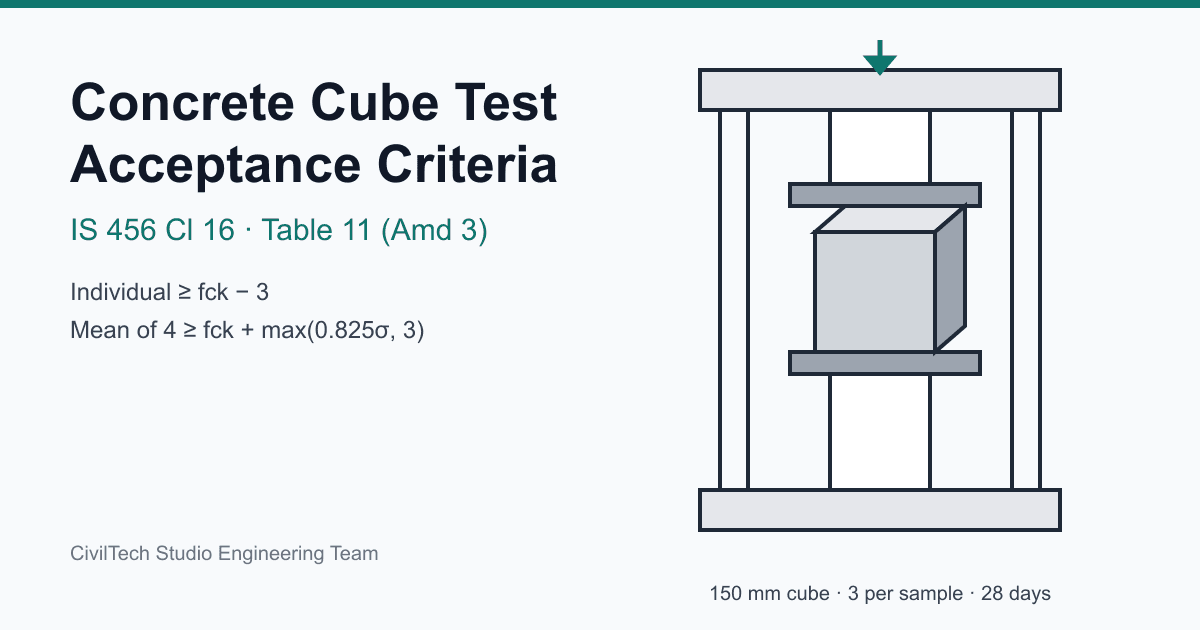
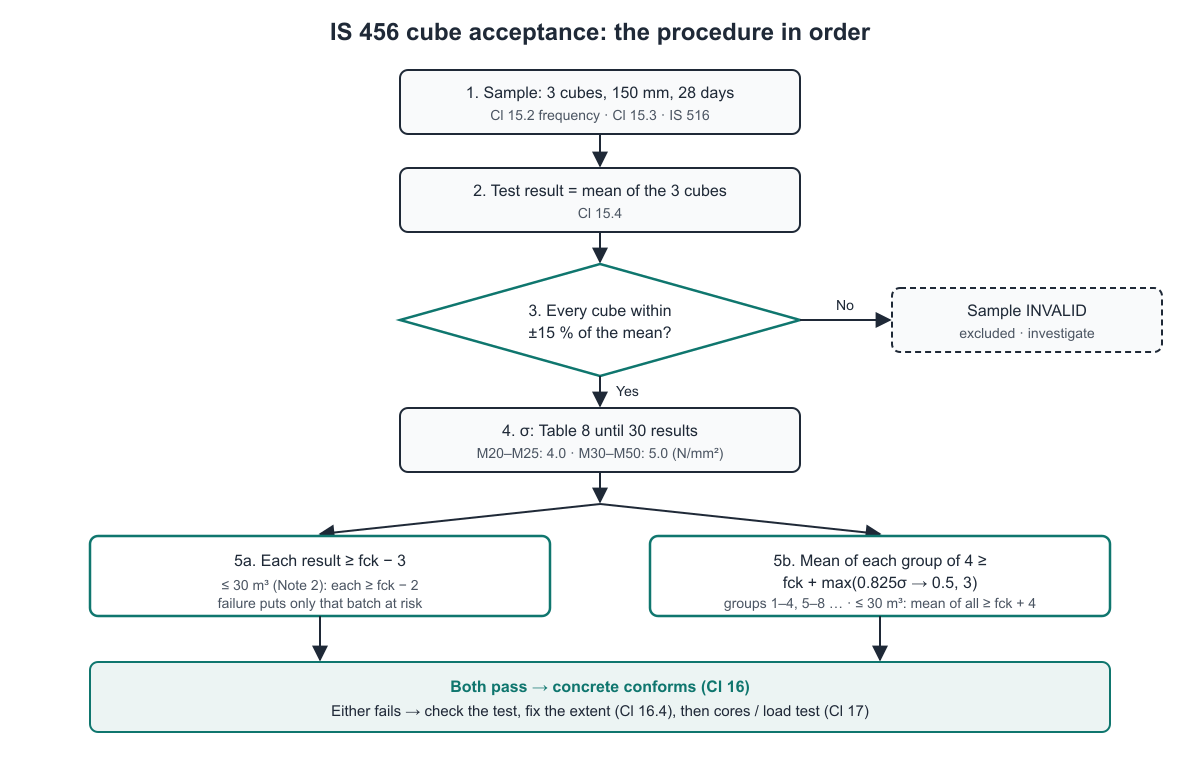
Under IS 456:2000 Clause 16 and Table 11 (as amended by Amendment No. 3), concrete of grade M15 and above is accepted when two conditions hold. First, the mean of every group of four non-overlapping consecutive test results must be at least fck + 0.825σ (rounded to the nearest 0.5 N/mm²) or fck + 3 N/mm², whichever is greater. Second, every individual test result must be at least fck − 3 N/mm². A "test result" is the average of three 150 mm cubes from one sample, tested at 28 days. For M25 with the IS 456 Table 8 standard deviation of 4.0 N/mm², the group mean must reach 28.5 N/mm² and no single result may fall below 22.0 N/mm².
The rest of this guide covers how samples are taken, when a sample is invalid, how the limits change for small pours, and a full worked register of ten M25 pours with every number checked by hand.
What governs concrete cube acceptance in India
Four documents set the rules:
- IS 456:2000, Clause 15 covers sampling: how often (15.2), how many specimens per sample (15.3), and what counts as a test result (15.4).
- IS 456:2000, Clause 16 and Table 11 set the acceptance criteria. Amendment No. 3 (2007) replaced the original table, which used fck − 4 and fck + 4 for M20 and above. Many site registers and older textbooks still use the old values.
- IS 456:2000, Table 8 gives the assumed standard deviation to use until the site has enough results to calculate its own.
- IS 516 is the test method (casting, curing and crushing the cubes). IS 1199 covers sampling the fresh concrete.
If cubes fail, Clause 17 applies: core tests, load tests and other checks on the hardened concrete.
How many cube samples are needed: sampling frequency
IS 456 Cl 15.2.2 sets the minimum number of samples by the quantity of each grade placed:
| Quantity of concrete in the work (m³) | Number of samples |
|---|---|
| 1–5 | 1 |
| 6–15 | 2 |
| 16–30 | 3 |
| 31–50 | 4 |
| 51 and above | 4, plus one for each additional 50 m³ or part of it |
Take at least one sample from each shift. Each sample gives three cubes for the 28-day test (Cl 15.3). Cubes for a 7-day check are extra and are cast from the same sample.
Step-by-step: how to check cube test results against IS 456
Step 1: Work out the sample result
The test result of a sample is the average of its three 28-day cubes (Cl 15.4). Strength per cube = failure load ÷ loaded area. For a 150 mm cube the area is 22,500 mm², so a failure load of 675 kN gives 675,000 ÷ 22,500 = 30.0 N/mm².
Step 2: Reject invalid samples
If any one cube differs from the sample average by more than ±15 %, the result of that sample is invalid (Cl 15.4). An invalid sample is left out of the acceptance check. Do not simply drop the odd cube and average the other two. Record the sample as invalid and investigate it. A sample with fewer than three cubes does not meet Cl 15.3 either.
Step 3: Choose the standard deviation σ
Until you have 30 valid results for that grade on that site (Cl 9.2.4.1), use the assumed value from Table 8:
| Grade | Assumed σ (N/mm²) |
|---|---|
| M10, M15 | 3.5 |
| M20, M25 | 4.0 |
| M30 to M50 | 5.0 |
The note under Table 8 adds 1 N/mm² to these values where site control falls short of the stated practices (proper cement storage, weigh batching, controlled water and regular checks). Once you have 30 or more results, use the established standard deviation calculated from them.
Step 4: Calculate the two limits
Individual limit  = fck − 3
Group-mean limit  = fck + max( round_to_0.5(0.825 × σ), 3 )
For M25 with σ = 4.0: 0.825 × 4.0 = 3.30, which rounds to 3.5. That is more than 3, so the group-mean limit is 25 + 3.5 = 28.5 N/mm². The individual limit is 25 − 3 = 22.0 N/mm².
Step 5: Group the results in fours, without overlap
Take the valid results in the order the concrete was placed and split them into groups of four that do not overlap: results 1–4, 5–8, 9–12 and so on. Each group mean must reach the group-mean limit. Results left over at the end wait for the next group. A rolling average (1–4, 2–5, 3–6) is a different test. It is not what Table 11 asks for.
Step 6: Check every individual result
Each valid result must be at least fck − 3. One low result puts at risk only the batch that sample came from. A low group mean puts at risk all the concrete from the first sample of the group to the last (Cl 16.4).
Step 7: Small pours (30 m³ or less)
When the total quantity of a grade is 30 m³ or less, fewer than four samples are taken, so no group of four ever forms. Note 2 to Table 11 then applies:
- The mean of all samples must be at least fck + 4.
- Each individual result must be at least fck − 2.
- If there is only one sample, its result must be at least fck + 4.
For M25 that means a mean of 29.0 N/mm² and no result below 23.0 N/mm².
Step 8: Use 7-day results as an early warning only
7-day cubes are not part of the IS 456 acceptance check. They are useful for spotting a bad batch three weeks early. With ordinary Portland cement, 7-day strength is often around 65 % of the 28-day strength, but the figure depends on the cement, the mix and the curing temperature. Treat a low 7-day result as a reason to check the batch tickets, curing and cube-making, not as a failure.
Worked example: an M25 cube test register with ten pours
A G+2 frame is cast in M25. Ten pours are logged with three 28-day cubes and two 7-day cubes each. We have fewer than 30 results, so σ comes from Table 8 (4.0 N/mm²).
These figures come from the CivilTech Studio engine function that runs the cube test register. The hand checks below confirm each step.
Sample results
| Pour | Element | 28-day cubes (N/mm²) | Result (mean) | 7-day mean | Status |
|---|---|---|---|---|---|
| P1 | Raft | 31.0, 32.5, 30.8 | 31.43 | 21.50 | OK |
| P2 | Columns GF | 29.5, 30.0, 28.6 | 29.37 | 20.00 | OK |
| P3 | Beams FF | 27.0, 28.5, 26.4 | 27.30 | 18.25 | OK |
| P4 | Slab FF | 30.2, 29.0, 31.1 | 30.10 | 20.25 | OK |
| P5 | Columns FF | 26.0, 27.2, 25.5 | 26.23 | 17.25 | OK |
| P6 | Beams SF | 28.0, 27.5, 29.0 | 28.17 | 18.75 | OK |
| P7 | Slab SF | 21.0, 22.0, 21.5 | 21.50 | 13.75 | Below individual limit; 7-day flag |
| P8 | Columns SF | 29.0, 28.4, 30.0 | 29.13 | 19.25 | OK |
| P9 | Staircase | 30.0, 24.0, 31.0 | 28.33 | 19.50 | Invalid (±15 % rule) |
| P10 | Roof slab | 28.5, 29.5, 30.5 | 29.50 | 19.75 | Waiting for its group of four |
Hand checks
P9 validity. Mean = (30.0 + 24.0 + 31.0) ÷ 3 = 28.33. The ±15 % band is 0.15 × 28.33 = 4.25, so the cubes must lie between 24.08 and 32.58. The 24.0 cube is 4.33 below the mean, outside the band. The P9 result is invalid and leaves the acceptance check. That leaves nine valid results.
Limits. Individual limit = 25 − 3 = 22.0. Group-mean limit = 25 + max(3.5, 3) = 28.5. The nine valid results have a sample standard deviation of 2.90 N/mm². With fewer than 30 results, the Table 8 value of 4.0 still governs, so the limits stay at 22.0 and 28.5.
Group 1 (P1–P4): (31.43 + 29.37 + 27.30 + 30.10) ÷ 4 = 118.20 ÷ 4 = 29.55 ≥ 28.5. Passes.
Group 2 (P5–P8): (26.23 + 28.17 + 21.50 + 29.13) ÷ 4 = 105.03 ÷ 4 = 26.26 < 28.5. Fails.
Individual results: P7 = 21.50 < 22.0. Fails. Every other valid result is at least 26.23.
7-day flag: the module flags a 7-day mean below 0.9 × 0.65 × fck = 0.9 × 0.65 × 25 = 14.63 N/mm². P7 at 13.75 is flagged. That warning came three weeks before the 28-day failure.
P10 is the ninth valid result, so it starts group 3 and waits for three more results.
Result summary
| Check | Requirement | Value | Verdict |
|---|---|---|---|
| Invalid samples (Cl 15.4) | All cubes within ±15 % | P9: 24.0 is 4.33 from 28.33 | P9 excluded, investigate |
| Individual results | ≥ 22.0 N/mm² | Minimum 21.50 (P7) | 1 non-conformance |
| Group 1, P1–P4 | Mean ≥ 28.5 N/mm² | 29.55 | Conforms |
| Group 2, P5–P8 | Mean ≥ 28.5 N/mm² | 26.26 | Non-conformance |
| 7-day trend | ≥ 14.63 N/mm² | P7: 13.75 | Early warning (not acceptance) |
| Overall | 2 non-conformances + 1 invalid sample | Review required |
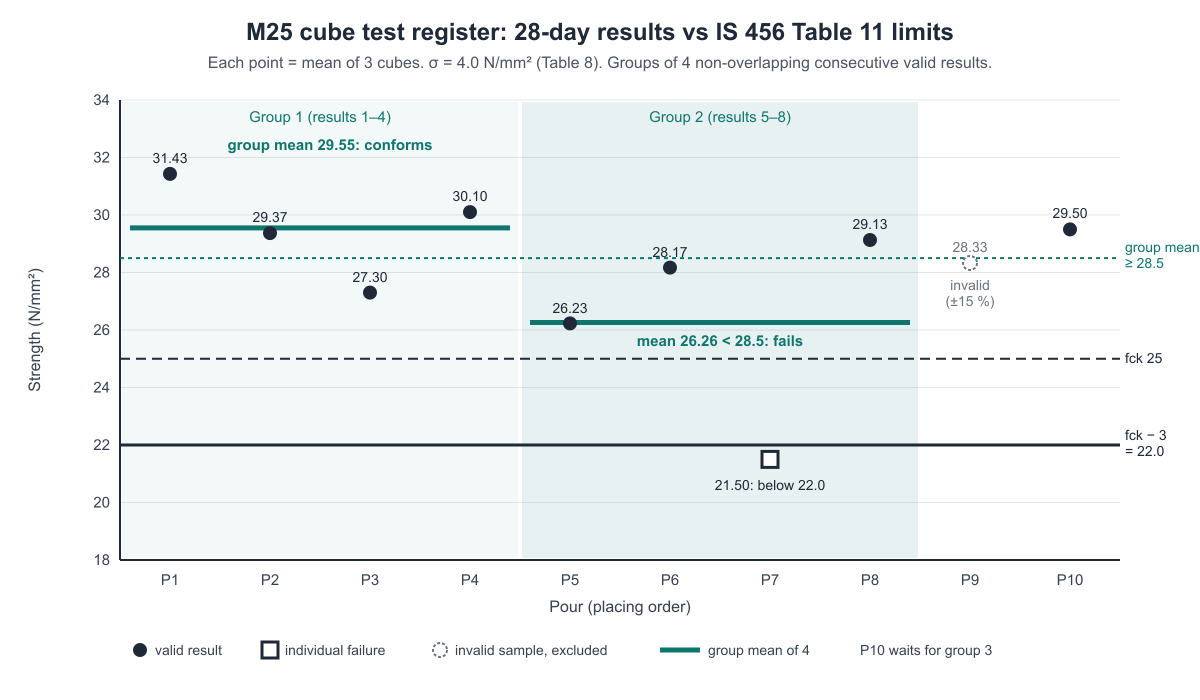
Group 2 is the useful lesson here. P5 (26.23) is above fck and well above the individual limit, but it is weak enough that, together with P7, it pulls the group mean below 28.5. The group criterion catches a drift in quality that no single-result check would show. All concrete from pour P5 to pour P8 is now in question. That covers the first-floor columns and the second-floor beams, slab and columns.
Acceptance limits by grade (Table 8 σ, more than 30 m³)
These limits apply until the site has its own standard deviation from 30 results:
| Grade | fck | σ (Table 8) | 0.825σ → nearest 0.5 | Group mean ≥ | Individual ≥ |
|---|---|---|---|---|---|
| M15 | 15 | 3.5 | 2.89 → 3.0 | 18.0 | 12.0 |
| M20 | 20 | 4.0 | 3.30 → 3.5 | 23.5 | 17.0 |
| M25 | 25 | 4.0 | 3.30 → 3.5 | 28.5 | 22.0 |
| M30 | 30 | 5.0 | 4.13 → 4.0 | 34.0 | 27.0 |
| M35 | 35 | 5.0 | 4.13 → 4.0 | 39.0 | 32.0 |
| M40 | 40 | 5.0 | 4.13 → 4.0 | 44.0 | 37.0 |
IS 456 clause reference for cube testing
| Clause | What it says (summary) |
|---|---|
| 9.2.4.1 | At least 30 results are needed to establish a site standard deviation |
| Table 8 | Assumed standard deviation by grade, +1 N/mm² where site control is poor |
| 15.2.2 | Sampling frequency by quantity; at least one sample per shift |
| 15.3 | Three specimens per sample for the 28-day test |
| 15.4 | Test result = average of 3 specimens; any specimen outside ±15 % makes the sample invalid |
| 16.1 / Table 11 (Amd 3) | Group-of-4 mean and individual limits for M15 and above |
| Table 11, Note 2 | Up to 30 m³: mean ≥ fck + 4, individual ≥ fck − 2, single sample ≥ fck + 4 |
| 16.4 | How much concrete a failing individual result or failing group puts at risk |
| 17 | Investigation of hardened concrete: cores, load tests, non-destructive tests |
What to do when cube results fail
- Check the test first. Look at the cube-making record, curing tank temperature, the age at test, the machine calibration and the failure pattern. Invalid samples and odd cubes often point to the test, not the concrete.
- Fix the extent. Under Cl 16.4, a failing individual result puts only its own batch at risk. A failing group puts every batch from its first sample to its last at risk. A cube test register that records the element against each pour makes this a lookup instead of an argument.
- Test the structure (Cl 17). Core tests are the usual next step. Under Cl 17.4, the concrete in the member is acceptable if the average equivalent cube strength of the cores is at least 85 % of the cube strength of the grade for that age, and no single core is below 75 %. Rebound hammer and ultrasonic pulse velocity tests help decide where to drill. They do not replace cores.
- Decide on the structure. If cores also fail, the engineer can recheck the design at the strength achieved, order a load test or specify strengthening.
Common mistakes in cube test registers
- Using fck − 4 and fck + 4. These are the pre-2007 values for M20 and above. The amended Table 11 uses fck − 3 for the individual limit and fck + 3 as the floor for the group mean, for all grades from M15.
- Rolling groups. Table 11 asks for non-overlapping groups of four consecutive results, not a moving average.
- Checking single cubes. The test result is the mean of three cubes. A single 21 N/mm² cube in an otherwise good M25 sample is not a failure. If it is more than 15 % from the mean, the sample is invalid.
- Averaging the two good cubes. Dropping the odd cube and averaging the rest hides an invalid sample.
- Using the site SD too early. A standard deviation from 9 results is not an established value. Use Table 8 until you have 30. A small, tidy data set can give a low SD that makes the group limit too easy.
- Mixing grades or plants. Assess each grade separately. Keep separate registers when two RMC plants supply the same grade.
- Ignoring Note 2. On a 20 m³ job you will never get a group of four. Without Note 2 the register shows "no group failures" when nothing was actually checked.
- Treating 7-day results as acceptance. They are a trend check. Accept or reject on 28-day results only.
How CivilTech Studio does this
The Cube Test Register applies exactly the procedure above to the pours you log:
- Pour register. Each pour has an ID, element, date, its 28-day cubes and optional 7-day cubes. You can paste the whole register from Excel or CSV (tab- or semicolon-separated columns: ID, element, date, 28-day cubes, 7-day cubes).
- Validity checks. Samples with fewer than three cubes, or with a cube outside ±15 % of the sample average, are marked INVALID with the reason and left out of acceptance (Cl 15.3/15.4).
- Standard deviation. It uses the Table 8 value as a floor until the register holds 30 valid results, then the register's own SD. You can also enter an established site SD.
- Both Table 11 criteria. The individual limit fck − 3 and the group mean of four non-overlapping consecutive results against fck + max(0.825σ rounded to 0.5, 3). Grades M15 to M50 are supported.
- Note 2 for small pours. Enter a total quantity of 30 m³ or less and it switches to fck + 4 / fck − 2.
- 7-day trend flags. Set the expected 7-day fraction (default 0.65). Pours below 90 % of that fraction × fck are flagged.
- Charts. A strength chart with the fck, individual and group lines, and a Shewhart control chart with ±2σ warning and ±3σ action limits to spot drift.
- Outputs. Individual and group failure tables, plain-language notes, a design-review checklist and share links.
It is free to use. For the mix behind the cubes, see the concrete mix design tool, which works out the target mean strength the register is testing against. The clause summaries are in the IS code reference.
FAQ
What is the acceptance criteria for concrete cube test as per IS 456?
For M15 and above, under Table 11 as amended: the mean of each group of four non-overlapping consecutive results must be at least fck + 0.825σ (rounded to the nearest 0.5 N/mm²) or fck + 3 N/mm², whichever is greater. Every individual result must be at least fck − 3 N/mm². For M25 with σ = 4.0, that is 28.5 N/mm² and 22.0 N/mm².
How many cubes are required for a concrete cube test?
Three cubes per sample for the 28-day test (IS 456 Cl 15.3), plus extra cubes for any 7-day check. The number of samples depends on quantity: one for 1–5 m³, two for 6–15 m³, three for 16–30 m³, four for 31–50 m³, and one more for every further 50 m³ or part of it. Take at least one sample per shift.
Is fck − 4 still the individual limit for M20 and above?
No. That was the original 2000 text. Amendment No. 3 (2007) revised Table 11 so that grades M15 and above use fck − 3 for individual results and fck + 3 as the minimum margin for the group mean. Check which edition your contract specification refers to.
What percentage of 28-day strength should concrete reach at 7 days?
With OPC, around 65 % is a common expectation, but it varies with cement type, mix and temperature. Blended cements gain strength more slowly. IS 456 does not use 7-day results for acceptance, so treat them as an early warning.
What happens if a concrete cube test fails?
First check the test itself. Then identify which concrete is at risk: the single batch for an individual failure, or all batches in the group for a group failure. Then investigate the structure under Cl 17, usually with core tests. Cores are acceptable if their average equivalent cube strength is at least 85 % of the specified strength and no core is below 75 %.
When is a cube sample result invalid?
When any one of its three cubes differs from the sample average by more than 15 % (IS 456 Cl 15.4). The sample is then left out of the acceptance check and should be investigated. It is not averaged from the two remaining cubes.
How do you calculate standard deviation for cube test results?
σ = √[Σ(x − x̄)² ÷ (n − 1)], where x is each valid sample result and n is the number of results. IS 456 accepts a site value only once there are at least 30 results. Until then, use Table 8: 3.5 N/mm² for M10–M15, 4.0 for M20–M25 and 5.0 for M30–M50.
Educational reference. Always verify against the governing code and your project specification.