#concrete#quantity-estimation#cement#m20#site-engineering
Cement, Sand and Aggregate for 1 m³ Concrete: M20 and M25 Quantities
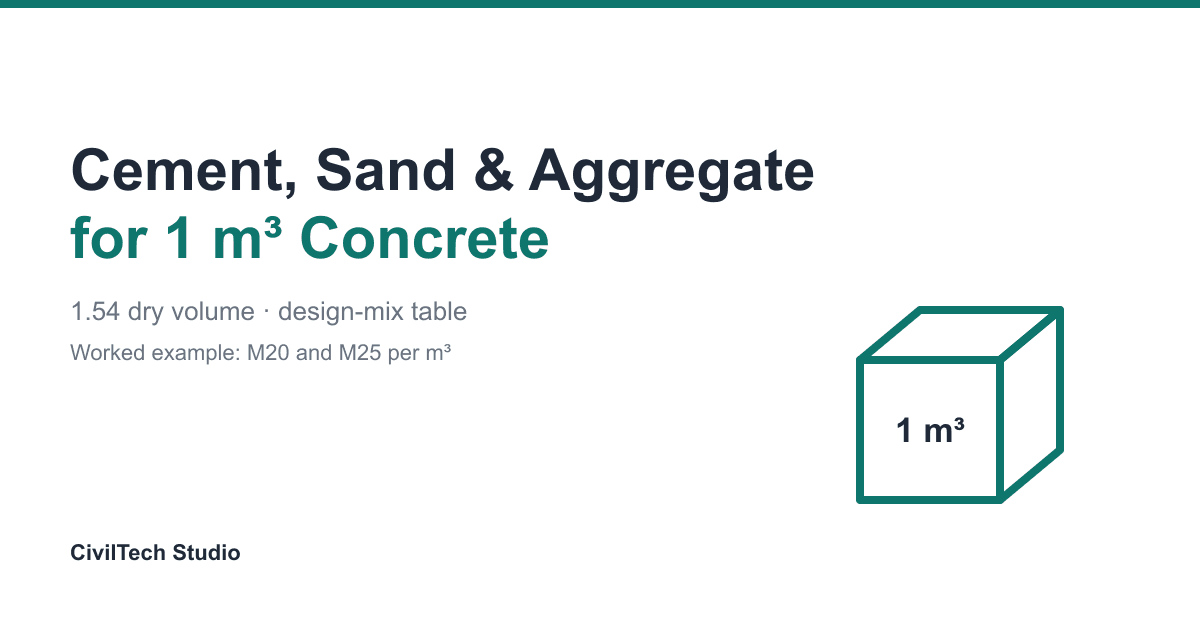
How many bags of cement and how much sand and aggregate go into 1 m³ of M20 or M25 concrete: the 1.54 dry volume method compared with a design-mix table.
Updated 4 Nov 20268 min read
 Try it free: open this worked example in Concrete Mix DesignOpen →
On this page
"How many bags of cement for one cubic metre?" is the first question on almost every small job. There are two common ways to answer it. The 1.54 dry volume method uses volume ratios such as 1:1.5:3. The design-mix method starts from water content and water-cement ratio. They give different answers, and it helps to know why.
This post works through both for M20 and M25. The free cost estimator uses the second method, and this post shows its figures exactly. For an actual mix, use the concrete mix design module.
Method 1: the 1.54 dry volume method
When cement, sand and aggregate are mixed with water, the fine particles fill the voids between the coarse ones and the volume shrinks. So 1 m³ of wet concrete needs more than 1 m³ of dry materials. Site practice takes the dry volume as 1.54 times the wet volume. Some references use a slightly different factor, so check which one your estimate uses.
Dry volume = 1.54 × wet volume
Cement (m³)    = dry volume × cement part / sum of parts
Sand (m³)      = dry volume × sand part / sum of parts
Aggregate (m³) = dry volume × aggregate part / sum of parts
Bags of cement = cement (m³) / 0.0347
One 50 kg bag of cement is taken as 0.0347 m³.
M20 (1 : 1.5 : 3), per 1 m³
- Sum of parts = 1 + 1.5 + 3 = 5.5
- Cement = 1.54 × 1 / 5.5 = 0.280 m³, so 0.280 / 0.0347 = 8.07 bags (about 403 kg)
- Sand = 1.54 × 1.5 / 5.5 = 0.420 m³
- Aggregate = 1.54 × 3 / 5.5 = 0.840 m³
M25 (1 : 1 : 2), per 1 m³
- Sum of parts = 4
- Cement = 1.54 × 1 / 4 = 0.385 m³, so 11.10 bags (555 kg)
- Sand = 0.385 m³
- Aggregate = 0.770 m³
The M25 answer has a problem. IS 456:2000 Cl 8.2.4.2 limits cement content to 450 kg/m³ (9 bags), not counting fly ash and ground granulated blast furnace slag. A 1:1:2 volume mix at 555 kg/m³ is over that limit. Volume ratios are a rough guide for M20 and below. Grades above M20 are design mixes, proportioned to IS 10262.
Method 2: design-mix proportions (what the cost estimator uses)
The cost estimator does not use the 1.54 factor. It uses indicative design-mix proportions per m³ of placed concrete, for OPC 43 and 20 mm aggregate. Each grade is held inside IS 456:2000:
- Water-cement ratio no more than 0.55, the Table 5 maximum for RCC in mild exposure.
- 186 L of water for M20, the IS 10262:2019 Table 4 figure for 20 mm aggregate. So M20 needs 186 / 0.55 = 338 kg of cement, taken as 6.8 bags (340 kg).
- Cement no more than 450 kg/m³ (Cl 8.2.4.2), so M40 is held at 9.0 bags.
| Grade | Cement (bags) | Cement (kg) | Sand (m³) | 20 mm aggregate (m³) | Water (L) | w/c |
|---|---|---|---|---|---|---|
| M20 | 6.8 | 340 | 0.46 | 0.90 | 186 | 0.55 |
| M25 | 8.0 | 400 | 0.42 | 0.84 | 186 | 0.47 |
| M30 | 8.6 | 430 | 0.40 | 0.80 | 186 | 0.43 |
| M40 | 9.0 | 450 | 0.38 | 0.76 | 165 | 0.37 |
These are per 1 m³ of concrete in place, before wastage.
Why the two methods give different answers
For M20, the volume method gives 8.07 bags and the design-mix table gives 6.8 bags. The difference is real, not a rounding error.
- The volume method fixes the ratio of loose volumes. It ignores the grading of the sand and aggregate, and the water. It tends to give more cement than a controlled mix needs.
- The design-mix method starts from how much water the aggregate needs for workability and the water-cement ratio the grade and exposure need. Cement follows from those two. With good aggregate and control, the same strength comes from less cement.
Neither figure replaces a trial mix. Use the volume method for a quick check on a small job, and the design-mix figures for budgeting. Use a proper mix design for the concrete you will actually pour.
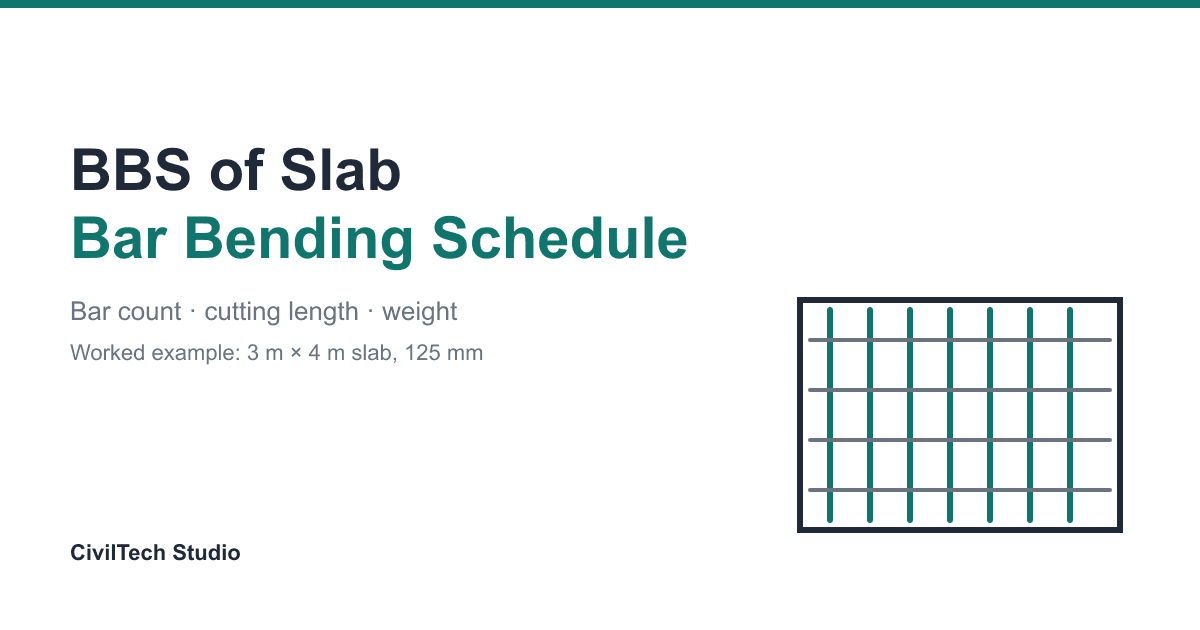
Worked example: a 4 m × 3 m × 125 mm slab in M20
These are the figures the cost estimator works out for one row: a slab, grade M20, 1.5 m³, with its default 4% wastage and the Tier-2 rate card.
- Volume = 4 × 3 × 0.125 = 1.5 m³
- With 4% wastage: 1.5 × 1.04 = 1.56 m³
- Cement = 1.56 × 6.8 = 10.61 bags (530 kg), so buy 11 bags
- Sand = 1.56 × 0.46 = 0.718 m³
- Aggregate = 1.56 × 0.90 = 1.404 m³
- Water = 1.56 × 186 = 290 L
- Steel at the typical slab ratio of 80 kg/m³ = 1.5 × 80 = 120 kg (on the volume placed)
- Formwork at the slab ratio of 8 m² per m³ = 1.5 × 8 = 12 m² (the 4 × 3 m soffit)
With the Tier-2 default rates, the estimator prices this row at:
| Item | Quantity | Cost |
|---|---|---|
| Cement | 10.61 bags at ₹400 | ₹4,243 |
| Sand | 0.718 m³ at ₹1,800 | ₹1,292 |
| Aggregate | 1.404 m³ at ₹1,500 | ₹2,106 |
| Water | 290 L at ₹0.05 | ₹15 |
| Steel | 120 kg at ₹65 | ₹7,800 |
| Formwork | 12 m² at ₹450 | ₹5,400 |
| Labour | 1.5 m³ at ₹1,500 | ₹2,250 |
| Total | ₹23,105 |
Steel, formwork (8 m² per m³ for a slab) and labour are on the 1.5 m³ actually placed. Wastage is concrete bought and lost, not concrete reinforced or shuttered.
For comparison, the 1.54 method for the same 1.56 m³ gives 12.59 bags of cement, 0.655 m³ of sand and 1.310 m³ of aggregate.
Common mistakes
- Leaving out the dry volume factor. Taking 1 m³ of dry materials for 1 m³ of concrete gives about a third too little of everything.
- Using 1:1:2 for M25 without checking cement content. It gives 555 kg/m³, over the 450 kg/m³ limit in IS 456 Cl 8.2.4.2.
- Forgetting wastage. Spillage, over-excavation and the last half-barrow add up. Allow for it before rounding up bags.
- Measuring damp sand by volume. Damp sand bulks, so a box of wet sand holds less sand than a box of dry sand. Allow for bulking or batch by weight.
- Treating any per-m³ table as a mix design. The figures above are for estimating. The actual proportions come from a mix design and a trial mix.
How CivilTech Studio does this
The cost estimator builds a bill of quantities from rows. Each row is an element (slab, beam, column, footing, raft or RCC wall) with a grade (M20, M25, M30 or M40), a volume and a count. For every row, it works out the cement, sand, aggregate, water, steel, formwork and labour, prices them and adds them up. Wastage is 4% by default and you can change it. It has rate presets for a Tier-2 default, Mumbai, Delhi NCR, Bangalore and Chennai, and you can edit every rate. It also gives the embodied carbon and exports a PDF. The screen shows the cost of each material rather than the bag count. To get bags, multiply the row's volume, including wastage, by the table above.
Related tools:
- Concrete mix design: mix proportions to IS 10262:2019, ACI 211 or BS 8500, with a nominal mix output.
- RC estimator: a full building take-off that does use Method 1. Its dry volume factor is a setting, 1.54 by default, with one bag taken as 0.0347 m³. It holds the cement in any mix at the 450 kg/m³ cap, so its M25 (1:1:2) take-off is 9 bags with 0.385 m³ of sand and 0.770 m³ of aggregate per m³.
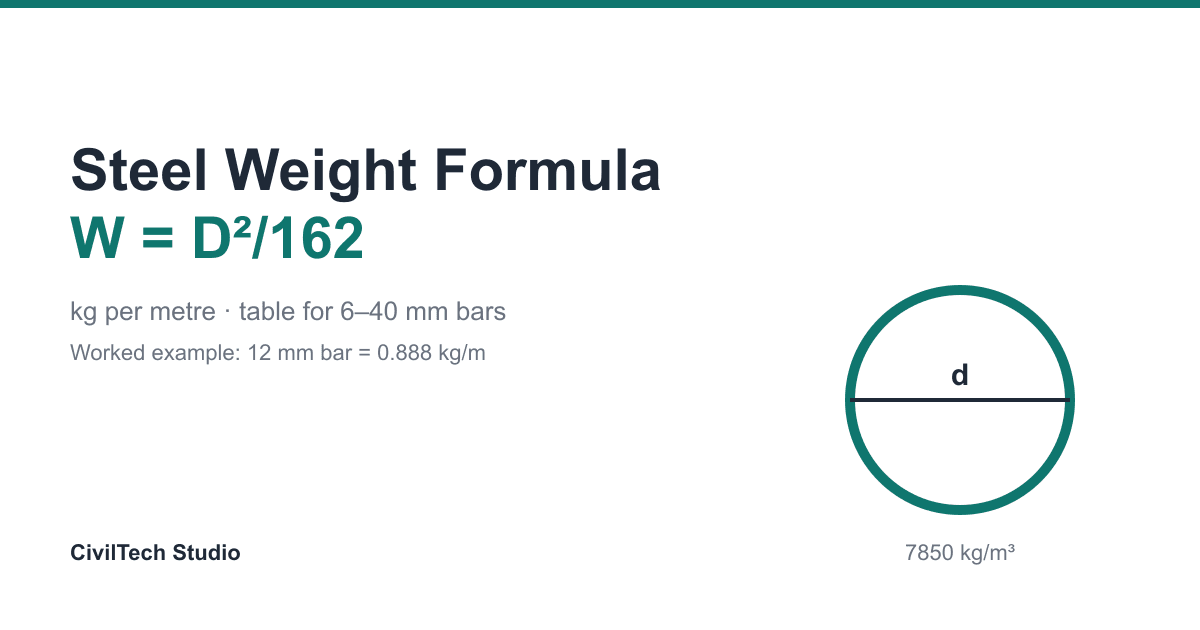
- Steel weight calculator: bar weights from the IS 1786 nominal mass (about d²/162).
FAQ
How many bags of cement are needed for 1 m³ of M20 concrete?
By the 1.54 dry volume method with a 1:1.5:3 mix, 8.07 bags (about 403 kg). The CivilTech Studio cost estimator uses design-mix proportions instead and takes 6.8 bags (340 kg), from 186 L of water at a water-cement ratio of 0.55.
How much sand and aggregate is needed for 1 m³ of M20 concrete?
By the 1.54 method, 0.420 m³ of sand and 0.840 m³ of aggregate. The cost estimator's design-mix figures are 0.46 m³ of sand and 0.90 m³ of 20 mm aggregate.
Why is 1.54 used in concrete quantity calculation?
Wet concrete occupies less volume than the loose dry materials that make it, because the fine particles and cement paste fill the voids between the aggregate. The 1.54 factor converts 1 m³ of wet concrete to the dry volume of materials needed.
How many cement bags are needed for 1 m³ of M25 concrete?
A 1:1:2 volume mix gives 11.10 bags (555 kg), which is over the 450 kg/m³ limit in IS 456 Cl 8.2.4.2. The cost estimator takes 8.0 bags (400 kg) with 186 L of water. Use a design mix for M25.
What is the volume of one bag of cement?
One 50 kg bag is taken as 0.0347 m³ in quantity calculations.
How much water is needed for 1 m³ of concrete?
It depends on the aggregate and the workability needed. The cost estimator takes 186 L for M20, M25 and M30 (IS 10262:2019 Table 4, 20 mm aggregate) and 165 L for M40, with the water-cement ratio kept at 0.55 or less.
Educational reference. The per-m³ figures are for estimating, not a mix design. Always confirm against IS 456:2000, IS 10262:2019 and your project specification.