#steel-weight#reinforcement#bbs#quantity-estimation#site-engineering
Steel Weight Formula D²/162: Rebar Weight per Metre with Table
How to calculate the weight of a steel bar with D²/162: where 162 comes from, a kg/m table for 6 to 40 mm bars, and worked examples for 12 mm bars.
Updated 4 Nov 20266 min read
 Try it free: open this worked example in Section DesignOpen →
On this page
Steel is bought, billed and checked by weight, but drawings give it as bar diameters and lengths. The link between the two is the unit weight of a bar in kg per metre, and on site everyone works it out with one short formula: D²/162.
This post explains where the formula comes from, gives a ready table for every common bar size and works two examples. To skip the arithmetic, the free steel weight calculator gives the unit weight, total weight, tonnage and cost for any diameter.
The formula
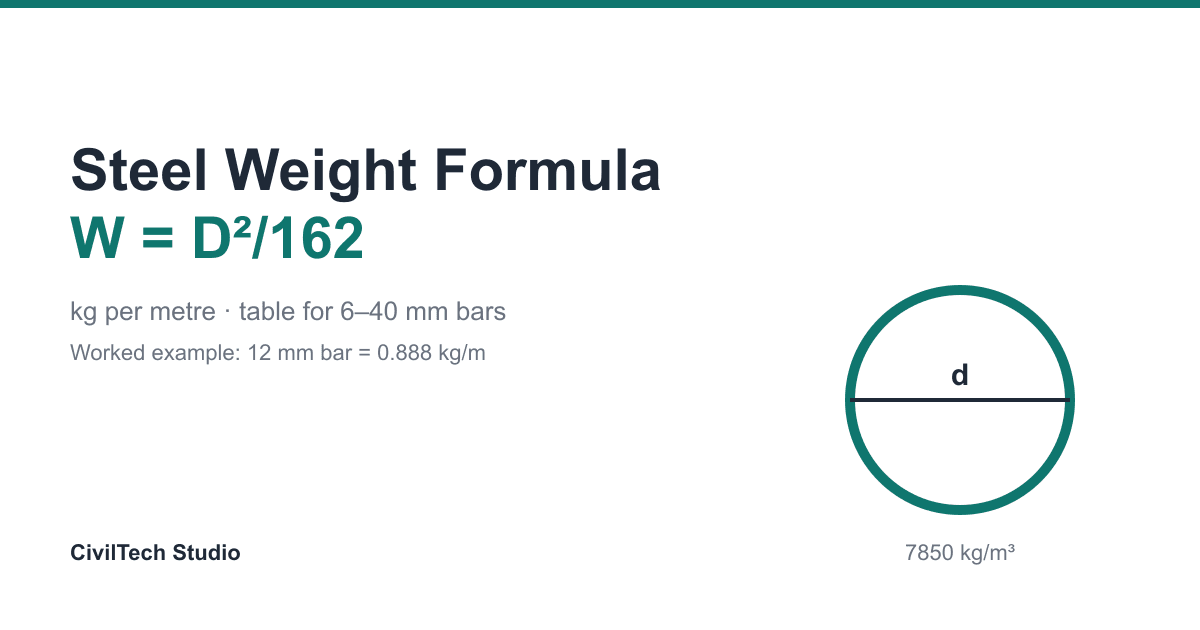
W = d² / 162 (kg per metre, d in mm)
- W: weight of the bar per metre length (kg/m)
- d: nominal bar diameter in millimetres
This is the site rule of thumb. The exact nominal mass, which IS 1786 tabulates and the calculator uses, is (π/4) × d² × 7850 / 10⁶ kg/m, about 0.1% less. The examples and the table below use the exact value.
Multiply W by the total length of bars in metres to get the total weight in kg:
Total weight (kg) = W × length per bar (m) × number of bars
Where 162 comes from
A round bar of diameter d mm has a cross-sectional area of π d²/4 mm², which is π d²/4 × 10⁻⁶ m². One metre of it has that volume in m³. Steel weighs 7850 kg/m³, so:
W = (π/4) × d² × 10⁻⁶ × 7850 = d² / 162.2
The divisor works out to 162.2, and site practice rounds it to 162. For a 12 mm bar, the exact value is 0.8878 kg/m and d²/162 gives 0.889 kg/m, a difference of about 0.1%. That is far smaller than the rolling tolerance on real bars, so the rounded formula is fine for quantities. IS 1786 and the calculator use the exact figure (0.888 kg/m for 12 mm), and so do the examples below.
Worked example 1: 10 bars of 12 mm, each 12 m long
- Unit weight: W = (π/4) × 12² × 7850 / 10⁶ = 0.888 kg/m (the site rule 144 / 162 gives 0.889)
- Total length: 12 m × 10 bars = 120 m
- Total weight: 0.8878 × 120 = 106.5 kg (0.107 t)
- At an illustrative rate of ₹65/kg, the cost is about ₹6,925.
So one 12 m length of 12 mm bar weighs about 10.65 kg. This is the number most people are actually searching for when they ask for the weight of a 12 mm bar.
Worked example 2: a column cage
A column has 4 bars of 16 mm and 4 bars of 12 mm, each cut to 3.6 m.
- 16 mm: W = (π/4) × 16² × 7850 / 10⁶ = 1.578 kg/m. Weight = 4 × 3.6 × 1.5783 = 22.73 kg
- 12 mm: W = 0.888 kg/m. Weight = 4 × 3.6 × 0.8878 = 12.78 kg
- Main bars total: 35.51 kg
Add the ties separately. Their cutting length comes from the stirrup formula, which you can work out in the BBS cutting length calculator.
Reference table: weight of steel bars
The weights are the IS 1786 nominal masses, (π/4) × d² × 7850 / 10⁶. The d²/162 rule gives figures about 0.1% higher.
| Bar diameter | Weight per metre | Weight of one 12 m bar | 12 m bars per tonne |
|---|---|---|---|
| 6 mm | 0.222 kg/m | 2.66 kg | 375.5 |
| 8 mm | 0.395 kg/m | 4.74 kg | 211.2 |
| 10 mm | 0.617 kg/m | 7.40 kg | 135.2 |
| 12 mm | 0.888 kg/m | 10.65 kg | 93.9 |
| 16 mm | 1.578 kg/m | 18.94 kg | 52.8 |
| 20 mm | 2.466 kg/m | 29.59 kg | 33.8 |
| 25 mm | 3.853 kg/m | 46.24 kg | 21.6 |
| 32 mm | 6.313 kg/m | 75.76 kg | 13.2 |
| 40 mm | 9.865 kg/m | 118.38 kg | 8.4 |
Two quick checks you can do in your head:
- Doubling the diameter multiplies the weight by four. 8 mm is 0.3946 kg/m, so 16 mm is 4 × 0.3946 = 1.578 kg/m.
- 10 mm is about 0.617 kg/m. Scale from there by (d/10)²: 20 mm is 4 × 0.6165 = 2.466 kg/m.
Common mistakes
- Using d in centimetres or using the radius. The 162 only works with the diameter in millimetres. A 1.2 "cm" bar gives 0.0089 kg/m, which is clearly wrong.
- Using D²/162 for non-round sections. Flats, angles and square bars need their actual cross-sectional area × 7850 kg/m³.
- Forgetting laps, hooks and bends in the total length. The weight is only as good as the length. Use cutting lengths from a bar bending schedule (BBS), not the clear span.
- Ordering steel from the bare formula. Real bars are rolled to a tolerance, and ribs change the mass slightly. Order from a detailed BBS with wastage and lap allowances, and check the weight on the supplier's bill.
- Mixing kg and tonnes. 106.5 kg is 0.107 t, not 1.07 t. Write the unit on every line.
How CivilTech Studio does this
The steel weight calculator uses the exact IS 1786 nominal mass, (π/4) × d² × 7850 / 10⁶, and shows the d²/162 figure beside it as a check. You enter the bar diameter (with quick picks for 8, 10, 12, 16, 20 and 25 mm), the length per bar, the number of bars and an optional rate in ₹/kg. It shows the unit weight, total length, total weight in kg and tonnes, and the cost, with each step written out. A reference table on the same page lists 6 mm to 40 mm bars.
Related tools:
- BBS cutting length calculator: the cut length of straight bars, L-bars and stirrups, with IS 2502 bend deductions.
- Rebar area and spacing calculator: the steel area per metre that a bar size and spacing give.
- Development and lap length calculator: the extra length to add where bars are lapped.
- Cost estimator: an early budget uses typical steel ratios per m³ of concrete (80 kg/m³ for a slab, 130 for a beam, 220 for a column, 75 for a footing).
- Section Design: an itemised BBS with shape codes, laps and cutting lengths for a designed member.
FAQ
What is the formula for the weight of a steel bar per metre?
W = d²/162, with d the bar diameter in mm and W in kg per metre. It comes from the area of a round bar multiplied by the density of steel, 7850 kg/m³. The exact form is (π/4) × d² × 7850 / 10⁶, which is what IS 1786 tabulates.
What is the weight of a 12 mm steel bar per metre?
0.888 kg/m, the IS 1786 nominal mass. The d²/162 rule gives 0.889 kg/m (144 ÷ 162). A full 12 m length of 12 mm bar weighs about 10.65 kg.
Why do we divide by 162 in the steel weight formula?
Because (π/4) × 7850 ÷ 10⁶ = 1 ÷ 162.2. The 7850 is the density of steel in kg/m³ and the 10⁶ converts mm² to m². Rounding 162.2 to 162 changes the result by about 0.1%.
How many 12 mm bars are there in one tonne?
About 94. One 12 m length of 12 mm bar weighs 10.65 kg, and 1000 ÷ 10.65 = 93.9 bars.
Is D²/162 accurate for TMT bars?
It is accurate enough for estimating and for a BBS. The formula assumes a round bar at 7850 kg/m³. Real TMT bars vary a little because of rolling tolerance and ribs, so weigh a sample or check the mill certificate when you need the actual mass.
How do I calculate the total steel weight from a BBS?
For each bar mark, multiply the number of bars by the cutting length to get the total length in metres. Multiply that by the unit weight for the bar's diameter (the table above, or d²/162 as a quick check). Add up all the bar marks, usually grouped by diameter, and add a wastage allowance before ordering.
Educational reference. The d²/162 rule assumes round bars at a steel density of 7850 kg/m³. Order steel from a detailed bar bending schedule and confirm weights against the supplier's bill.