#earthwork#surveying#quantity-estimation#road-construction#site-engineering
Earthwork Calculation: Prismoidal vs Average End Area (Worked Example)
Work out cutting and filling volumes from cross-sections by the average end area and prismoidal methods, with bulking, shrinkage and a 100 m road example.
Updated 4 Nov 20268 min read
 Try it free: run this design in Geotechnical AnalysisOpen →
On this page
Every road, canal, embankment and levelled plot starts with the same question: how many cubic metres of soil have to be dug out, and how many have to be brought in? The answer comes from cross-sections taken at regular chainages, and from one of two formulas: the average end area method or the prismoidal formula. They give different answers on the same data, and that difference is real money when you are paying for excavation and haulage.
This guide explains both methods, shows the prismoidal correction, and then turns the cut and fill volumes into a net balance using bulking and shrinkage. To run your own sections, use the free earthwork volume calculator, which does both methods side by side.
What you need before you start
Earthwork volume is calculated from areas, not levels. At each chainage along the alignment you need:
- the cut area (m²): the part of the section where the natural ground is above the formation and has to be excavated
- the fill area (m²): the part where the formation is above the ground and has to be built up
A section on sidelong ground can have both. Keep them separate; never subtract fill from cut at the section level. The areas come from your levels and the design section, either by hand (the method of coordinates or by counting squares) or from a drawing.
Method 1: average end area
Treat each interval between two sections as a slab whose area is the mean of its two ends:
V = L × (A1 + A2) / 2
- L: distance between the two sections (m)
- A1, A2: cut (or fill) areas at the two ends (m²)
Add up the intervals for the total. It works with any spacing, which is why it is the everyday site method.
Method 2: prismoidal formula (Simpson's rule)
Take the intervals two at a time. For each pair of equal intervals d, with areas A1, A2 and A3 at the three sections:
V = (d / 3) × (A1 + 4A2 + A3)
The formula is exact for a prismoid, a solid whose end faces are parallel and whose area varies smoothly between them. It needs pairs of equal intervals, which means an odd number of equally spaced sections. If the count is even or the spacing changes, the leftover interval has to be done by the end area method.
Prismoidal correction
The difference between the two methods is the prismoidal correction:
C = V(end area) − V(prismoidal)
When the area changes linearly from section to section, C is zero. When it changes sharply, the end area method usually gives more.
Bulking and shrinkage
Cut is measured in place, in bank cubic metres. Soil swells when it is dug (bulking) and settles when it is compacted in an embankment (shrinkage). To compare cut with fill on the same basis:
Fill (bank) = Fill / (1 − shrinkage)
Net = Cut − Fill (bank)          + surplus, − borrow
Haul (loose) = |Net| × (1 + bulking)
A positive net is surplus soil to cart away; a negative net is borrow material to bring in.
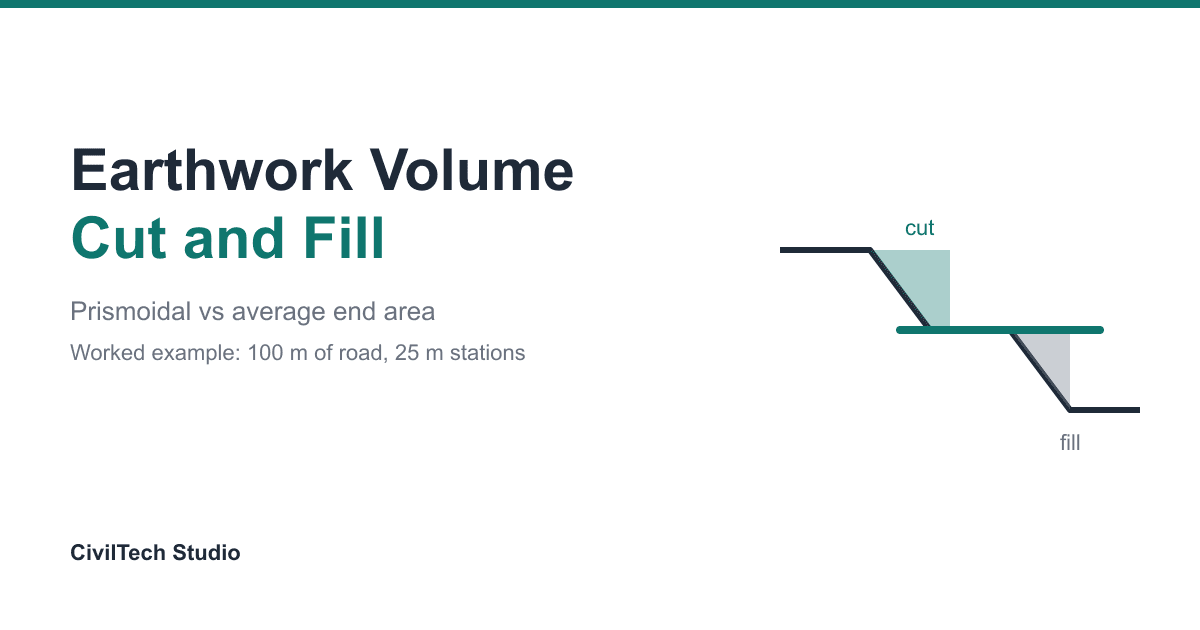
Worked example: 100 m of road at 25 m stations
Five cross-sections were taken at 25 m spacing. The road goes from cutting into embankment:
| Chainage (m) | Cut area (m²) | Fill area (m²) |
|---|---|---|
| 0 | 18 | 0 |
| 25 | 10 | 1 |
| 50 | 6 | 4 |
| 75 | 2 | 9 |
| 100 | 0 | 14 |
Bulking is taken as 25% and shrinkage as 10%, the calculator's defaults.
Step 1: average end area
- 0–25 m: cut = 25 × (18 + 10)/2 = 350 m³, fill = 25 × (0 + 1)/2 = 12.5 m³
- 25–50 m: cut = 25 × (10 + 6)/2 = 200 m³, fill = 25 × (1 + 4)/2 = 62.5 m³
- 50–75 m: cut = 25 × (6 + 2)/2 = 100 m³, fill = 25 × (4 + 9)/2 = 162.5 m³
- 75–100 m: cut = 25 × (2 + 0)/2 = 25 m³, fill = 25 × (9 + 14)/2 = 287.5 m³
Totals: cut 675 m³, fill 525 m³.
Step 2: prismoidal
There are four equal intervals, so they pair up exactly (0–50 m and 50–100 m), with d = 25 m.
- 0–50 m: cut = (25/3) × (18 + 4 × 10 + 6) = (25/3) × 64 = 533.33 m³, fill = (25/3) × (0 + 4 × 1 + 4) = 66.67 m³
- 50–100 m: cut = (25/3) × (6 + 4 × 2 + 0) = (25/3) × 14 = 116.67 m³, fill = (25/3) × (4 + 4 × 9 + 14) = (25/3) × 54 = 450.00 m³
Totals: cut 650.00 m³, fill 516.67 m³.
Prismoidal correction: cut 675 − 650 = 25.00 m³, fill 525 − 516.67 = 8.33 m³.
Step 3: balance and haul (prismoidal volumes)
- Bank material needed for the fill = 516.67 / (1 − 0.10) = 574.07 m³
- Net = 650.00 − 574.07 = 75.93 m³ bank, positive, so it is surplus
- Loose volume to haul away = 75.93 × 1.25 = 94.91 m³
With the end area volumes, the same steps give a fill bank volume of 583.33 m³, a surplus of 91.67 m³ and a haul of 114.58 m³. That is 19.68 m³ more loose soil to pay for on a single 100 m stretch.
Notice also what happens if you skip shrinkage and just subtract: 650 − 516.67 = 133.33 m³. That overstates the surplus by 57 m³, because the embankment will swallow more soil than its finished volume suggests.
Reference table: both methods, interval by interval
| Interval | End area cut (m³) | End area fill (m³) | Prismoidal cut (m³) | Prismoidal fill (m³) |
|---|---|---|---|---|
| 0–25 m | 350.0 | 12.5 | 533.33 (0–50 m) | 66.67 (0–50 m) |
| 25–50 m | 200.0 | 62.5 | ||
| 50–75 m | 100.0 | 162.5 | 116.67 (50–100 m) | 450.00 (50–100 m) |
| 75–100 m | 25.0 | 287.5 | ||
| Total | 675.0 | 525.0 | 650.00 | 516.67 |
An even number of sections
Add a sixth section at chainage 125 m with no cut and 16 m² of fill. Now there are five intervals. The calculator pairs 0–50 m and 50–100 m as before, and does the last interval, 100–125 m, by end area: 25 × (14 + 16)/2 = 375 m³ of fill. It flags one unpaired interval, and the fill total becomes 891.67 m³.
Common mistakes
- Netting cut against fill within a section. On sidelong ground a section can need both. Netting them hides excavation you will actually pay for.
- Using the prismoidal formula on unequal spacing. Simpson's rule only holds for equal pairs. With uneven chainages, use end areas for the odd intervals.
- Comparing bank cut with compacted fill. Without the shrinkage step the balance looks better than it is, and you run short of fill.
- Pricing haul on bank volume. Trucks carry loose soil. Multiply by (1 + bulking).
- Assuming the bulking and shrinkage figures. They depend on the soil. Take them from the soil report or a trial pit, not from a previous job.
How CivilTech Studio does this
The earthwork volume calculator takes one row per station: chainage, cut area and fill area. It sorts the rows by chainage, then:
- works out the volumes by either the prismoidal (Simpson) or the average end area method, interval by interval
- reports the prismoidal correction for cut and fill, whichever method you pick
- pairs equal intervals for Simpson's rule, uses end areas for any interval it cannot pair, and tells you how many there are
- applies bulking and shrinkage (25% and 10% by default, both editable) to give the bank volume of fill, the net surplus or borrow, and the loose haul volume
It does not calculate the section areas from levels and side slopes, and it does not draw a mass-haul diagram or work out haul distances or cost. For the rest of the job, the RCC cost estimator prices the concrete work, the retaining wall design tool covers a cutting or fill that needs a wall, and the geotechnical calculator checks the bearing capacity of the soil you are cutting into.
FAQ
What is the formula for earthwork calculation?
For each interval between cross-sections, the average end area formula is V = L × (A1 + A2)/2. The prismoidal formula, used over two equal intervals d, is V = (d/3) × (A1 + 4A2 + A3). Work out cut and fill separately and add up the intervals.
What is the difference between the prismoidal and average end area methods?
The end area method assumes the area changes linearly between sections. The prismoidal formula allows for a curved change and is exact for prismoids. In the example above the end area method gives 675 m³ of cut against 650 m³ by the prismoidal formula, a correction of 25 m³.
Why does the prismoidal formula need an odd number of sections?
Simpson's rule works on pairs of equal intervals, and pairs of intervals need an odd number of sections: 3, 5, 7 and so on. With an even number, one interval is left over and has to be done by the end area method.
How do you calculate cutting and filling volume for a road or plot?
Take cross-sections at regular chainages (or a grid for a plot), work out the cut and fill area at each, then apply the end area or prismoidal formula to cut and fill separately. Finally convert the fill to bank volume with the shrinkage factor and compare it with the cut.
How do bulking and shrinkage change the earthwork quantity?
Shrinkage increases the bank material needed for fill: 516.67 m³ of compacted fill needs 516.67 / 0.9 = 574.07 m³ of bank soil at 10% shrinkage. Bulking increases the volume you have to haul: 75.93 m³ of bank surplus becomes 94.91 m³ loose at 25% bulking.
Is earthwork measured in bank or loose cubic metres?
Excavation is normally measured in place, as bank volume, and that is how the calculator treats cut. Loose volume matters for trucks and spoil heaps, which is why the haul volume is given separately.
Educational reference. Check the section areas against your survey, and take bulking and shrinkage factors from the soil report before billing or ordering plant.