#is-875#wind-load#structural-analysis#loads#design-basics
Wind Load Calculation as per IS 875 Part 3 — Worked Example
Work out design wind speed Vz and wind pressure pd to IS 875 Part 3:2015, with the k1–k4 factors, a k2 table and worked examples for Hyderabad and Bhubaneswar.
Updated 4 Nov 20268 min read
On this page
Wind load on a building in India is worked out from IS 875 (Part 3):2015. The method is short: take the basic wind speed for the site, adjust it for risk, terrain, height, topography and cyclones to get the design wind speed, then turn that speed into a pressure. Most of the effort is in picking the right factors.
This guide explains each factor, gives the design wind pressure formula, and works two full examples: an ordinary building in Hyderabad and a hospital in the cyclonic belt at Bhubaneswar. To run your own numbers, use the free wind pressure calculator.
The formulas
Design wind speed (Cl 6.3)
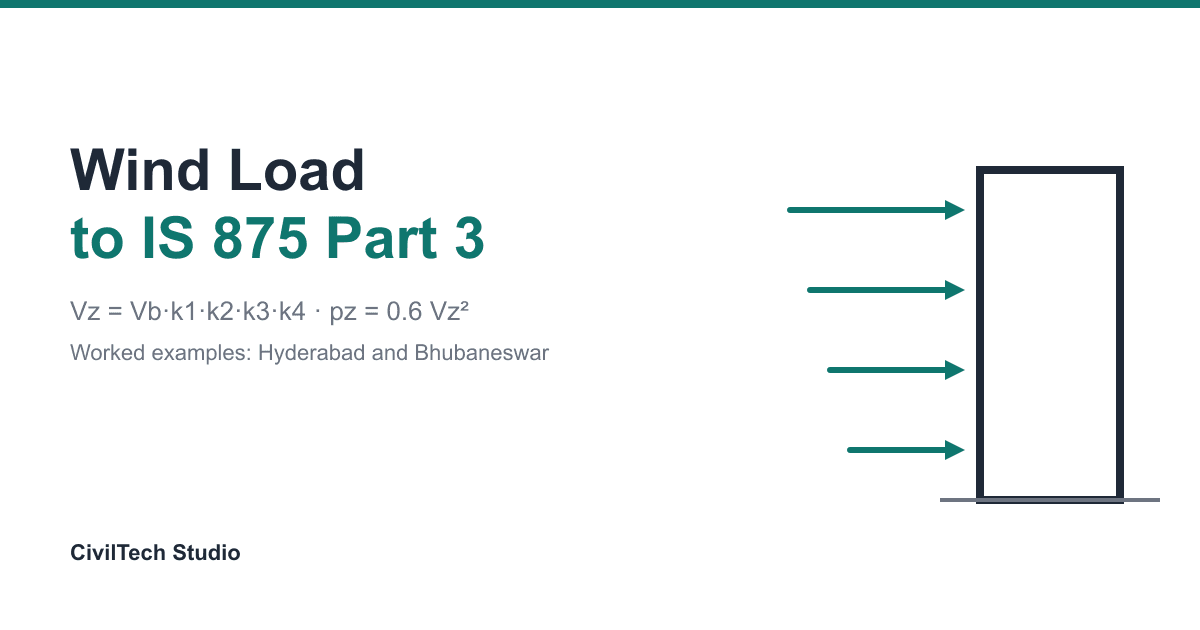
Vz = Vb × k1 × k2 × k3 × k4
- Vb: basic wind speed for the site (m/s), from the wind map
- k1: risk coefficient (Table 1)
- k2: terrain roughness and height factor (Table 2)
- k3: topography factor
- k4: importance factor for the cyclonic region (Cl 6.3.4)
Wind pressure and design wind pressure (Cl 7.2)
pz = 0.6 × Vz²                (N/m², with Vz in m/s)
pd = Kd × Ka × Kc × pz,  but not less than 0.7 × pz
- Kd: wind directionality factor, 0.90 for buildings and 1.00 for circular forms. In cyclone-affected regions Kd is taken as 1.0 (Cl 7.2.1).
- Ka: area averaging factor (Table 4): 1.0 for areas up to 10 m², 0.9 at 25 m², 0.8 at 100 m² and above
- Kc: combination factor (Cl 7.3.3.13), between 0.8 and 1.0
The factors, one by one
Basic wind speed, Vb
Vb is read from the wind map for the site. Values used by the calculator for common cities:
| City | Vb (m/s) |
|---|---|
| Bengaluru | 33 |
| Ahmedabad, Pune | 39 |
| Mumbai, Hyderabad | 44 |
| Delhi, Jaipur | 47 |
| Chennai, Kolkata, Bhubaneswar | 50 |
For other places, read Vb from the code and enter it directly.
Risk coefficient, k1 (Table 1)
k1 depends on the class of structure and on Vb. Some values from Table 1:
| Class of structure | Vb = 44 m/s | Vb = 50 m/s |
|---|---|---|
| General buildings and structures (50-year life) | 1.00 | 1.00 |
| Temporary sheds, construction stage, boundary walls (5-year) | 0.73 | 0.70 |
| Low hazard: isolated towers, farm buildings (25-year) | 0.91 | 0.90 |
| Important: hospitals, communication, power plants (100-year) | 1.07 | 1.08 |
Terrain and height factor, k2 (Table 2)
k2 grows with height and falls as the terrain gets rougher, from category 1 (open sea coast, flat open land) to category 4 (dense city centres with tall buildings). Below 10 m the 10 m value is used, and between the listed heights you interpolate linearly.
| Height (m) | Category 1 | Category 2 | Category 3 | Category 4 |
|---|---|---|---|---|
| 10 | 1.05 | 1.00 | 0.91 | 0.80 |
| 15 | 1.09 | 1.05 | 0.97 | 0.80 |
| 20 | 1.12 | 1.07 | 1.01 | 0.80 |
| 25 (interpolated) | 1.135 | 1.095 | 1.035 | 0.885 |
| 30 | 1.15 | 1.12 | 1.06 | 0.97 |
| 50 | 1.20 | 1.17 | 1.12 | 1.10 |
Topography factor, k3
k3 is 1.00 on flat ground and rises for hills, ridges and cliffs, up to 1.36. Work it out for the site and enter it.
Cyclonic importance factor, k4 (Cl 6.3.4)
Outside the cyclone-prone coastal belt, k4 = 1.0. Inside it:
| Structure in the cyclonic belt | k4 |
|---|---|
| Post-cyclone importance: shelters, hospitals, schools, towers | 1.30 |
| Industrial structures | 1.15 |
| All other structures | 1.00 |
Worked example 1: 25 m building in Hyderabad
- Vb = 44 m/s (Hyderabad)
- General building, k1 = 1.0
- Terrain category 2, height of the point considered h = 25 m
- Flat site, k3 = 1.00; not in a cyclonic belt, k4 = 1.00
- Building, so Kd = 0.90; cladding panel area about 25 m², so Ka = 0.90; Kc = 1.00
- k2 at 25 m. Table 2 gives 1.07 at 20 m and 1.12 at 30 m. Interpolating: 1.07 + (5/10) × (1.12 − 1.07) = 1.095.
- Design wind speed. Vz = 44 × 1.0 × 1.095 × 1.00 × 1.00 = 48.18 m/s.
- Wind pressure. pz = 0.6 × 48.18² = 0.6 × 2321.3 = 1392.8 N/m².
- Design wind pressure. Kd × Ka × Kc = 0.90 × 0.90 × 1.00 = 0.81, so pd = 0.81 × 1392.8 = 1128.2 N/m².
- Floor check. 0.7 × 1392.8 = 975.0 N/m², less than 1128.2, so the floor does not govern.
Design wind pressure at 25 m: pd = 1128.2 N/m², or about 1.13 kN/m².
When the 0.7 pz floor takes over
Keep everything the same but take a large wall area (Ka = 0.8) and Kc = 0.9. Now Kd × Ka × Kc = 0.9 × 0.8 × 0.9 = 0.648, which is below 0.7. The product would give 902.5 N/m², but the code does not allow pd below 0.7 pz, so pd = 975.0 N/m².
Worked example 2: hospital in the cyclonic belt, Bhubaneswar
- Vb = 50 m/s (Bhubaneswar)
- Important building (hospital), k1 = 1.08 at Vb = 50 m/s
- Terrain category 2, h = 25 m, so k2 = 1.095 as before
- Flat site, k3 = 1.00
- In the cyclonic belt, post-cyclone importance, k4 = 1.30
- Ka = 0.90, Kc = 1.00; Kd is forced to 1.0 because the site is cyclone-affected
- Vz = 50 × 1.08 × 1.095 × 1.00 × 1.30 = 76.87 m/s
- pz = 0.6 × 76.87² = 3545.3 N/m²
- pd = 1.0 × 0.90 × 1.00 × 3545.3 = 3190.8 N/m², about 3.19 kN/m²
That is nearly three times the Hyderabad pressure at the same height. The design speed enters squared, so the k1, k4 and Kd changes compound quickly.
Common mistakes
- Using Vb as the design speed. Vb is a reference speed at 10 m in open terrain. Always apply k1 to k4.
- Using one k2 for the whole building. k2 changes with height. Work out the pressure at several heights, or at least at the top.
- Reading k2 below 10 m. Table 2 starts at 10 m. Lower heights use the 10 m value, not an extrapolation.
- Keeping Kd = 0.9 in a cyclonic region. Cl 7.2.1 sets Kd = 1.0 there.
- Forgetting the 0.7 pz floor. When Ka and Kc are both reduced, the product can fall below 0.7.
- Mixing units. pz = 0.6 Vz² gives N/m². Divide by 1000 for kN/m² before adding it to dead and live loads.
- Treating pd as the load on the building. pd is a pressure on a surface. The force on a wall, roof or frame still needs the external and internal pressure coefficients (or force coefficients) and the area.
How CivilTech Studio does this
The wind pressure calculator lets you pick one of ten cities or enter your own Vb, then:
- interpolates k1 from Table 1 for the class of structure and k2 from Table 2 for terrain categories 1 to 4 up to 500 m
- takes k3 from you (1.00 to 1.36) and applies k4 for the cyclonic belt option you choose
- works out Vz, pz and pd, forces Kd = 1.0 in cyclonic regions, and shows when the 0.7 pz floor governs
It stops at the design wind pressure. It does not apply pressure or force coefficients, gust or dynamic response factors, or work out k3 from the site's topography.
To combine the wind load with dead and live loads, use the load combination generator. To see whether wind or earthquake governs the lateral design, compare with the seismic base shear calculator. The unit converter changes the pressure between N/m², kN/m² and other units.
FAQ
How to calculate wind load as per IS 875 Part 3?
Start from the basic wind speed Vb, multiply by k1, k2, k3 and k4 to get the design speed Vz, then find pz = 0.6 Vz² and pd = Kd × Ka × Kc × pz, not less than 0.7 pz. Multiply pd by the pressure coefficients and the area to get the force on each surface.
What is the design wind pressure formula?
IS 875 Part 3:2015 Cl 7.2 gives pz = 0.6 Vz² in N/m², and the design wind pressure pd = Kd × Ka × Kc × pz, with pd not less than 0.7 pz. For Vz = 48.18 m/s, pz = 1392.8 N/m² and, with Kd × Ka × Kc = 0.81, pd = 1128.2 N/m².
What is the basic wind speed for my city?
Read it from the wind map in IS 875 Part 3. Values the calculator uses include 33 m/s for Bengaluru, 39 m/s for Pune and Ahmedabad, 44 m/s for Mumbai and Hyderabad, 47 m/s for Delhi and Jaipur, and 50 m/s for Chennai, Kolkata and Bhubaneswar.
What are k1, k2, k3 and k4 in IS 875 Part 3?
k1 is the risk coefficient for the design life and class of structure, k2 the terrain roughness and height factor, k3 the topography factor for hills and slopes, and k4 the importance factor for structures in the cyclonic coastal belt.
How do I find k2 for a height between the table values?
Interpolate linearly. For terrain category 2 at 25 m, k2 lies between 1.07 at 20 m and 1.12 at 30 m, giving 1.095. Below 10 m use the 10 m value.
Why is Kd taken as 1.0 in cyclonic regions?
Kd = 0.9 is a reduction for wind direction: the strongest wind is not assumed to strike from the worst direction for the building. Cl 7.2.1 does not allow that reduction in cyclone-affected regions, so Kd is taken as 1.0 there, and the calculator sets it automatically when you choose a cyclonic option.
Educational reference. Always confirm the factors against IS 875 (Part 3):2015 and your project's design basis.