#bbs#stirrups#detailing#is-2502#site-engineering
Stirrup Cutting Length (IS 2502) — BBS Formula
Calculate the cutting length of a rectangular stirrup step by step: outside dimensions, 135° hooks per IS 13920 and the IS 2502 bend allowances, with a worked 230 × 450 mm beam example.
Updated 4 Nov 20265 min read
On this page
A stirrup looks simple, but cutting it to the wrong length wastes steel on every bar in the building, or worse, gives a hook that is too short to anchor. This post shows how to work out the cutting length of a 2-legged rectangular stirrup, the most common bar in any bar bending schedule (BBS).
To skip the arithmetic, the free BBS cutting length calculator does it for straight bars, L-bends and stirrups, and shows each step.
Why the cutting length isn't the outside dimension
When a bar is bent, the outer face stretches and the inner face compresses, so a bent bar "uses up" less straight length than its outside dimensions suggest. The bend deduction corrects for this. The common IS 2502 convention, with the legs measured to the outside of the bar, is:
| Bend angle | Allowance |
|---|---|
| 45° | 1d |
| 90° | 2d, deducted at a corner |
| 135° | 3d, added at a hook |
Here d is the bar diameter. At a 90° corner the two outside dimensions overstate the bar, so 2d comes off. A 135° hook is the other way round: the bar carries on round the bend before its straight extension starts, and that bend uses about 3d of bar, so 3d is added to each hook.
The formula
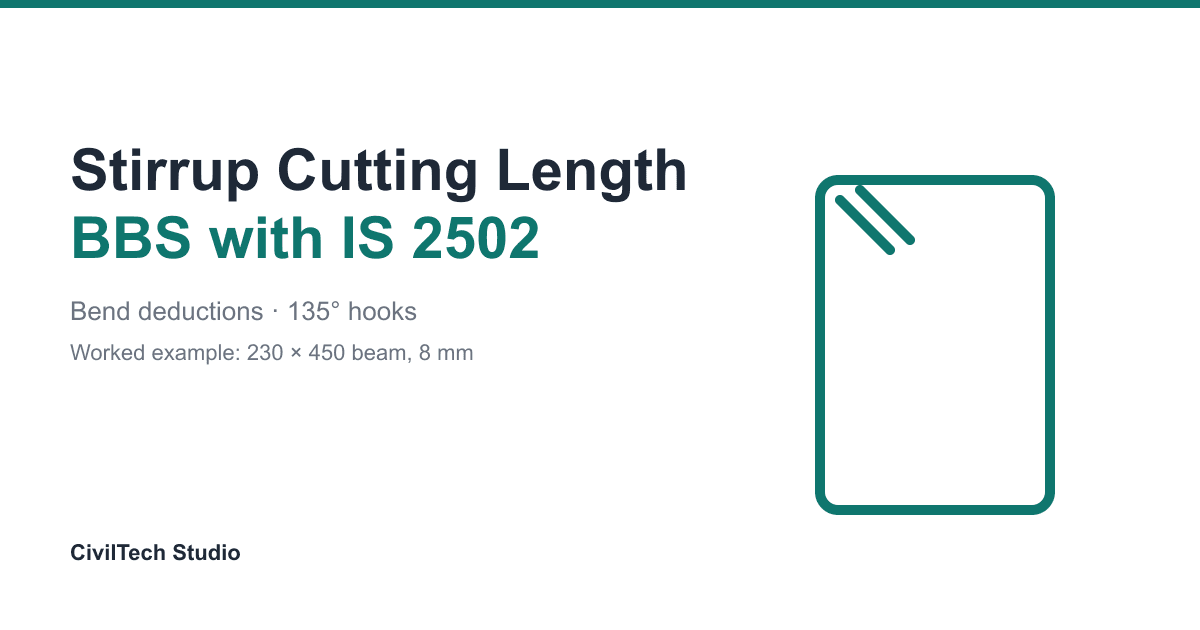
Cutting length = 2(a + b) − (3 × 2d) + 2 × (hook + 3d)
- a = B − 2 × cover, the outside width of the stirrup
- b = D − 2 × cover, the outside depth of the stirrup
- hook = the straight extension after each 135° bend
- 3 × 2d deducts the three 90° corners (the fourth corner is where the two hooks are)
- 2 × (hook + 3d) adds each 135° hook: its extension plus 3d for the bend itself
B and D are the beam width and depth. Cover is the clear cover to the stirrup.
You will also see a centre-line version, 2(a + b) + 2 × hook − (3 × 2d) − (2 × 3d) with a = B − 2 × cover − d. It takes the hook bends off instead of adding them, and on centre-line dimensions that counts the bends twice. For the beam below it gives 1162 mm, only 34 mm more than the bare closed loop (2(172 + 392) = 1128 mm), which cannot hold two 65 mm hook extensions.
How long is the hook?
- IS 13920:2016 (ductile detailing, seismic zones): 135° hook with an extension of 6d, but not less than 65 mm.
- Common site practice (and the old IS 13920:1993): 10d, but not less than 75 mm.
Use what your drawings specify. In seismic zones III–V the 135° hook is mandatory. Don't use 90° hooks for stirrups in earthquake-resisting members.
Worked example: 230 × 450 mm beam, 8 mm stirrups, 25 mm cover
- a = 230 − 2(25) = 180 mm (outside width)
- b = 450 − 2(25) = 400 mm (outside depth)
- Hook (IS 13920:2016) = max(6 × 8, 65) = max(48, 65) = 65 mm
- Corner deductions = 3 × (2 × 8) = 48 mm
- Hook allowances = 2 × (65 + 3 × 8) = 2 × 89 = 178 mm
- Cutting length = 2(180 + 400) − 48 + 178 = 1160 − 48 + 178 = 1290 mm
With the 10d practice hook, max(80, 75) = 80 mm, so each hook allowance is 80 + 24 = 104 mm and the cutting length becomes 1320 mm.
That 30 mm difference, multiplied by a few thousand stirrups, is why the hook rule belongs on the drawing.
Weight for the BBS
8 mm bar weighs (π/4) × 8² × 7850 / 10⁶ = 0.395 kg/m (d²/162 = 64/162 gives the same to three decimals). One 1290 mm stirrup is about 0.51 kg. For other diameters, use the steel weight calculator.
Common mistakes
- Mixing the two conventions. Outside dimensions (B − 2 × cover) go with the 2d corner deductions and the hook + 3d allowance. Taking d off for the centre line and also deducting 3d at each hook counts the bends twice and cuts the stirrup about 130 mm short (1162 mm instead of 1290 mm here).
- Forgetting the corner deductions. The bar comes out 3 × 2d too long (48 mm for an 8 mm stirrup), and site staff cut it down by eye.
- Hooks shorter than 65 mm on small diameters. For 8 mm bars, 6d is only 48 mm, so the 65 mm minimum governs.
Frequently asked questions
What is the formula for the cutting length of a stirrup?
For a 2-legged rectangular stirrup with 135° hooks: cutting length = 2(a + b) − (3 × 2d) + 2 × (hook + 3d), where a and b are the outside width and depth of the stirrup (B − 2 × cover and D − 2 × cover) and d is the bar diameter.
What are the bend deductions in a BBS?
The common IS 2502 convention allows 1d for a 45° bend, 2d for a 90° bend and 3d for a 135° bend. With the legs measured to the outside of the bar, a rectangular stirrup deducts 2d at each of its three 90° corners (6d in all) and adds 3d to each of its two 135° hooks, on top of the hook extension.
How long should a stirrup hook be?
IS 13920:2016 asks for a 135° hook with an extension of 6d, but not less than 65 mm. Common site practice (from the old IS 13920:1993) uses 10d, but not less than 75 mm. Use what your drawings specify.
What is the cutting length of an 8 mm stirrup for a 230 × 450 mm beam?
With 25 mm clear cover and IS 13920:2016 hooks, it is 1290 mm (a = 180 mm, b = 400 mm, hook = 65 mm, corner deductions = 48 mm, hook allowances = 178 mm). With 10d site-practice hooks it is 1320 mm.
How much does one 8 mm stirrup weigh?
An 8 mm bar weighs 0.395 kg/m (about d²/162), so a 1290 mm stirrup weighs about 0.51 kg.
Try it
Enter your own beam size, cover, bar diameter and hook rule in the free BBS cutting length calculator. For lap and anchorage lengths, see development and lap length to IS 456.
Educational reference. Bend deductions follow the common IS 2502 convention. Confirm against your project's bar bending standard before cutting steel.